Blog
Substances of Concern in Product Data: A Practical Guide
Which substances of concern belong in a product passport today, and which can wait for a delegated act? Teams often answer by collecting everything, then discover that much of what came back describes a product they stopped making. The narrower answer is more useful: a substance of concern is a chemical or substance group that regulation or hazard assessment flags, and what your record needs is its identity, how much is present, and where in the product it sits.
Table of Contents
- What Substances of Concern Are and Where They Appear
- Why Substances of Concern Matter for Product Data
- Thresholds and Deadlines That Set Your Data Scope
- What Information Companies May Need to Collect
- Worked Examples from Textiles, Electronics and Batteries
- How to Request and Check Supplier Substance Data
- Handling Incomplete, Changing or Conflicting Substance Data
- Common Questions and Your Next Step
What Substances of Concern Are and Where They Appear
Substances of concern are chemicals or substance groups that a regulation or a hazard assessment flags, because of toxicity, persistence, bioaccumulation or the way they interfere with reuse and recycling. They become a product-data problem the moment they sit in a material, a component or a finished article. The same chemical can be unremarkable in one part of a product and decisive in another.
An ingredient list tells you what a cake contains. A substances of concern record tells you which ingredient carries the risk, how much went in, and which layer it sits in. When a recycler asks whether the icing can travel in the same stream as the sponge, only the second kind of record answers the question.
That's the gap the Digital Product Passport (DPP) is meant to close. A DPP is a structured digital record of a product, reachable through a data carrier such as a QR code on the product, carrying identification, materials, substances, repair and disposal information. This guide uses DPP from here on.
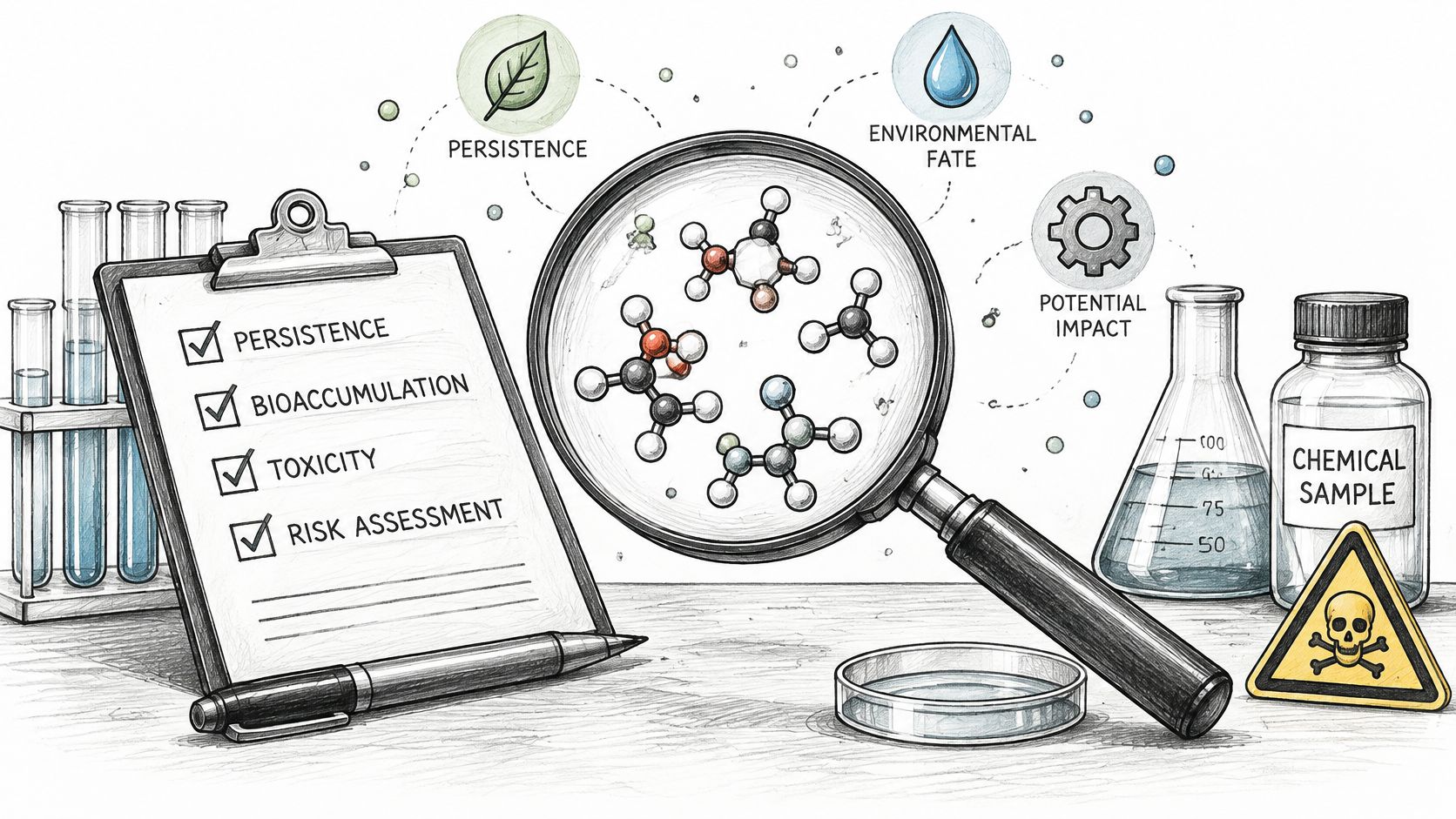
Four families cover most of what manufacturers meet: SVHCs on the REACH Candidate List, PFAS, restricted heavy metals such as lead and cadmium, and flame retardants. Add formaldehyde in boards, nickel release from plated surfaces and the substances in inks and adhesives, and you have a workable shortlist. Where each one tends to hide depends on the product group.
| Product group | Typical substance concerns | Where they usually sit |
|---|---|---|
| Textiles and fashion | PFAS in coated or waterproof fabrics; restricted dyes and finishes | Membranes, coatings, trims, dyed layers |
| Electronics and electrical equipment | Lead in solder; flame retardants in plastics | Solder joints, housings, cable sheathing |
| Batteries | Heavy metals and chemistry-specific substances | Cells, modules, casings |
| Metals | Restricted elements in alloys and plating; nickel release | Alloys, plated surfaces, jewellery components |
| Furniture and construction products | Flame retardants; formaldehyde in boards; PFAS in surface treatments | Foams, boards, surface coatings |
| Packaging | Substances in inks, coatings and adhesives | Printed layers, adhesives, coatings |
Presence alone isn't a breach. The questions that decide your obligations are how much is present, where it sits, and which rule applies to that product group.
Why Substances of Concern Matter for Product Data
The scale explains why this moved from the laboratory to the product record. EU production of chemicals classified as hazardous to human health reached 167 million tonnes in 2023, roughly 74 million tonnes below the 241 million tonnes recorded in 2007, according to the European Environment Agency's zero pollution dashboard, and EU consumption landed at the same 167 million tonnes. Lower aggregate volumes still leave the identification problem intact, because those substances remain in products on shelves and in units now going through design review.
Three reasons turn that into a data requirement.
- Substances sit inside components. The assembler signs for the finished jacket, device or battery pack, while the chemistry of concern entered earlier through a coating, a joint, a finish or a cell material that the assembler never bought.
- The rules ask for specifics. Substance information has to name each substance and give a concentration or range at the right product level. A yes/no question cannot produce that, however carefully the supplier fills it in.
- Status changes. Restriction activity is changing which substances reach the market: the European Chemicals Agency reported that the combined volume of substances subject to REACH authorisation placed on the EU market in 2021 was estimated to be 45% lower than in 2010, and by the end of 2020, 211 substances or groups of substances had reached the REACH Candidate List. A declaration that was accurate last year can be incomplete for the model you ship now, especially where one duty is already dated and another is still being defined for your product group.
A waterproof jacket certified in spring can stop matching its file by autumn if the membrane supplier changes a coating line. Nobody lied. The record went stale, and nothing in it pointed to the membrane.
The test to apply: if you cannot say which component holds the substance, how much is in it, which revision was assessed, and which date is binding rather than planned, you have a claim rather than a record.
Substance data needs identity, location, version and date. Treat it as a field attached to the component where the substance sits, with a status that separates settled duties from later delegated acts, and every summary becomes traceable.
Thresholds and Deadlines That Set Your Data Scope
A threshold works like a weighbridge: it only matters when a specific load crosses it, and each regime keeps its own. Mix them up and you get one of two failure modes, panic about rules that never covered you or calm about rules that do. Read the table row by row, then read the status column a second time.
The trigger most teams meet first
A producer or importer must notify ECHA when an article contains a Candidate List substance above 0.1% by weight and the total amount in all relevant articles exceeds 1 tonne per year, as set out in ECHA's guidance on Candidate List obligations. Both conditions must hold. A substance at 2% in a component you buy in small volumes may never reach the tonnage, and the tonnage is counted across all relevant articles rather than per product. The notification falls due six months after the substance enters the list, unless you can show that exposure to humans or the environment is excluded during normal or reasonably foreseeable use and disposal, or the substance has already been registered for that use.
SCIP then asks for detail a notification never needed. Where a Candidate List substance sits in an article, including inside a component article, ECHA's SCIP database expects the substance name, a concentration range and its location, plus what safe use and waste handling require. Notice that the SCIP row carries no tonnage test: the duty attaches to the article on the market once the concentration band is crossed. A cable gland with a listed plasticiser sits inside the SCIP net the day the product ships; whether you also owe a notification depends on the yearly total. Those ranges are expressed in weight percent and run from the decisive band just above 0.1% up to 100%, which is why a binary yes or no answer loses information a recycler or an inspector needs.
| Regime | Trigger | Threshold or date | Status |
|---|---|---|---|
| REACH Candidate List (article notification) | Candidate List substance in an article | Above 0.1% by weight and over 1 tonne per year across relevant articles | Notify ECHA within six months of listing, unless exemptions apply |
| SCIP database | Article on the EU market containing a Candidate List substance | Above 0.1% by weight, with concentration range and location | In force; supplier information required |
| ESPR substance information in DPPs | Product group covered by a delegated act | Set per product group in delegated acts | No universal date; depends on each delegated act |
| EU Battery Regulation passport | EV, LMT and industrial batteries above 2 kWh | Set to apply from 18 February 2027 | Date fixed in law |
| Battery substances report | Substances in or used in battery manufacture | Commission report due by 31 December 2027 | Date fixed in law |
Reading the status column
Two rows carry dates written into law. The consolidated Battery Regulation text sets the battery passport for EV batteries, LMT batteries and industrial batteries above 2 kWh to apply from 18 February 2027, and it gives the Commission, assisted by ECHA, until 31 December 2027 to report on substances of concern in batteries or used in their manufacture. Mind the wording of the threshold: greater than 2 kWh, not 2 kWh or more.
The ESPR row works differently. The European Commission's DPP FAQ states that the framework doesn't create one universal substance list for every product: information on substances of concern applies where a DPP is required, and precise thresholds and exemptions come from product-specific delegated acts. Until an act lands, "defined per act" is the honest state of play, and the safest scope to build is the one that already works under SCIP: each substance named, with a concentration and a component location, recorded against the model, batch or item it describes.
Practical rule: write the date you checked each row next to the row. A table without check dates turns into a rumour within a year.
Where a binding answer matters for a specific product, confirm the reading with your legal or compliance adviser before you build a process around it.
What Information Companies May Need to Collect
The field list isn't a matter of taste. It comes from requirements that already apply and from the fields a passport is most likely to need, and the balance shifts by product group.
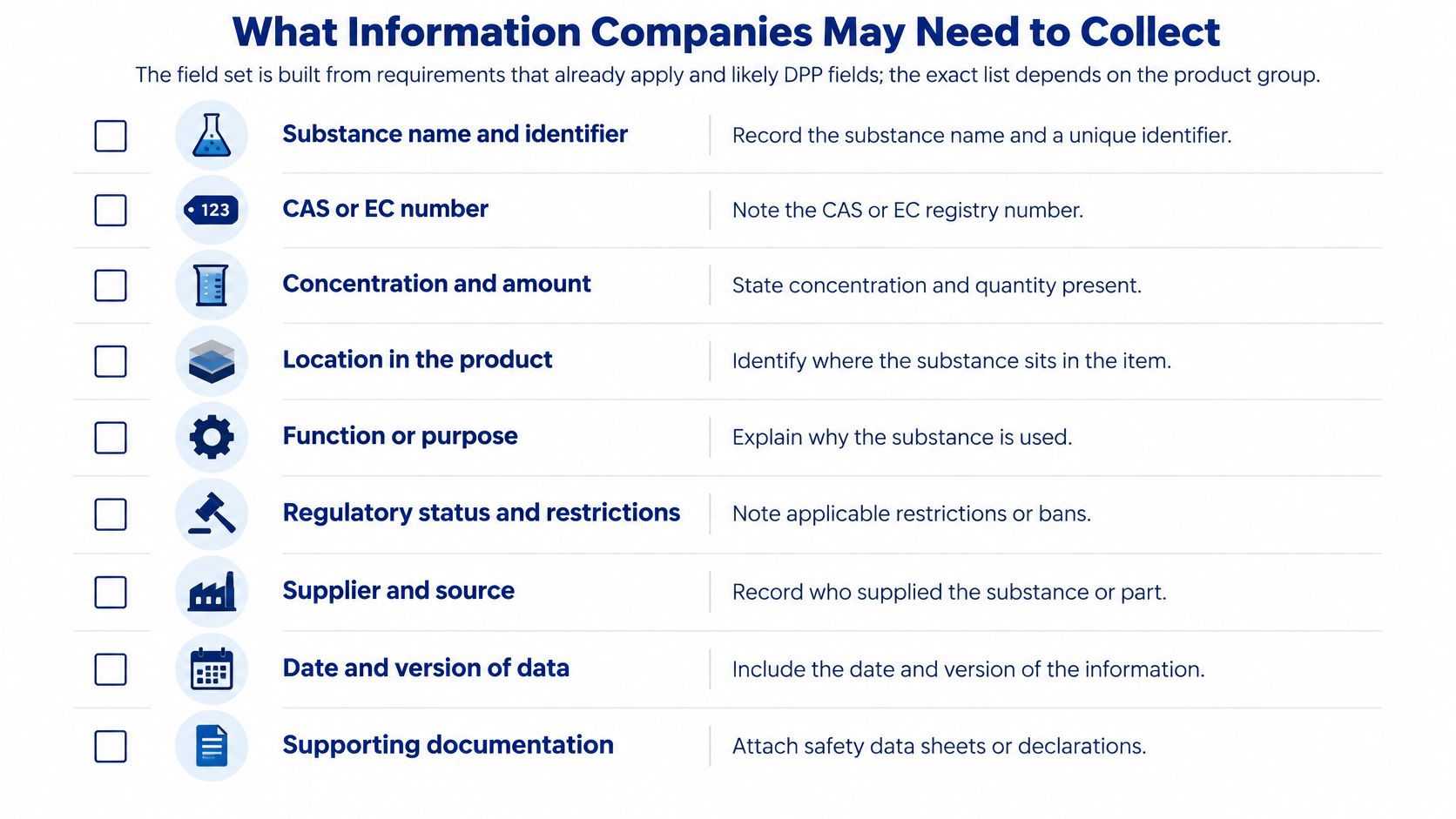
Under the ESPR, delegated acts may set both DPP requirements and requirements on substances of concern, and the information must at minimum identify each substance by name or numerical code and state its concentration, maximum concentration or concentration range at product level or for relevant components and spare parts (Regulation (EU) 2024/1781). That's the floor. In day-to-day records, it works out to nine fields per component.
| Data field | What it captures | Example | Basis |
|---|---|---|---|
| Substance identity | Name or numerical code | Lead, identified by CAS or EC number | ESPR; REACH |
| Concentration | Value, maximum or range | Above 0.1% by weight, range given | ESPR; SCIP |
| Location | Component, layer or part identifier | Lead in solder on a circuit board | ESPR; SCIP |
| Scope | Model, batch or item | Model TJ-400, batch 24-07 | Internal record; DPP |
| Supplier and date | Declaring supplier and declaration date | Coating supplier, declaration dated 10 March 2025 | Internal record; REACH evidence |
| Evidence basis | Declaration, test report or registration reference | Third-party test report for PFAS in a membrane | Internal evidence standard |
| Product version | Revision the data applies to | Design revision B | DPP versioning |
| Safe use and disposal | Handling, disassembly and disposal information | Disassembly note for a battery module | ESPR |
| Review status | Reviewer and confidence level | Approved by compliance, medium confidence | Internal control |
Sort the nine into three groups before anyone sends a questionnaire.
- Already required. Substance identity, concentration and location for Candidate List substances above the threshold, with the evidence behind them. REACH and SCIP drive this today.
- Likely to become DPP-relevant. Safe-use and disassembly notes, plus a clear tie between the substance record and the product revision it describes.
- Awaiting a delegated act. Which of these fields are mandatory for your product group, and at what threshold.
The temptation is to collect everything. It doesn't work well: indiscriminate requests produce inconsistent, unverifiable answers and exhaust the suppliers you most need. Ask for what a rule or a plausible passport field justifies, and mark the legal status of each field in your own record. Tying that field list to a revision rather than to a product family is what a structured product record is built for. Draft the list for your top ten products this month, one row per component, with the status written beside each field.
Worked Examples from Textiles, Electronics and Batteries
Three products, three supply chains, one pattern: the data you need usually sits one tier below the company that sells the finished item.
A waterproof jacket
A brand specifies a PFAS-treated membrane for a rain shell. The assembler can confirm stitching, zips and trims but has never bought the membrane chemistry. The request goes to the coating supplier and asks for the substance identity, the concentration range in the membrane, and which layer carries the treatment. A finished-garment letter saying "compliant" answers none of it.
A control board
An electronics assembler buys populated boards from a contract manufacturer, which buys solder alloy from a third supplier. Lead in solder is the classic case: the declaration must attach to the board's part identifier and revision, not to the product family, or the same document gets reused for a board built with a different alloy.
A battery pack
Battery teams hold two data layers, not one. The Battery Regulation (EU) 2023/1542 requires an electronic battery passport from 18 February 2027 for every light means of transport battery, every industrial battery with a capacity greater than 2 kWh and every electric vehicle battery placed on the market or put into service. It carries information about the battery model together with information specific to the individual battery, including data that arises during use. Cell, module and material suppliers therefore need a process for assigning incoming values to the right model and, where required, the right battery record. Our battery passport solution is configured per project around exactly that split between model data and item data.
The metals parallel
In an aluminium extrusion business, the billet supplier is asked for recycled content and footprint values per batch, because batch is the level at which a mill can report them. Ask a smelter for a per-item figure and you'll get an average that describes nothing.
The same record then serves different readers. A consumer sees fibre composition and care instructions, a recycler sees disassembly and substance location, an authority sees the evidence. Field-level access decides who sees which.
How to Request and Check Supplier Substance Data
Eight steps, in the order that keeps rework low. The most common failure isn't a supplier refusing to answer; it's asking the wrong supplier the wrong question.
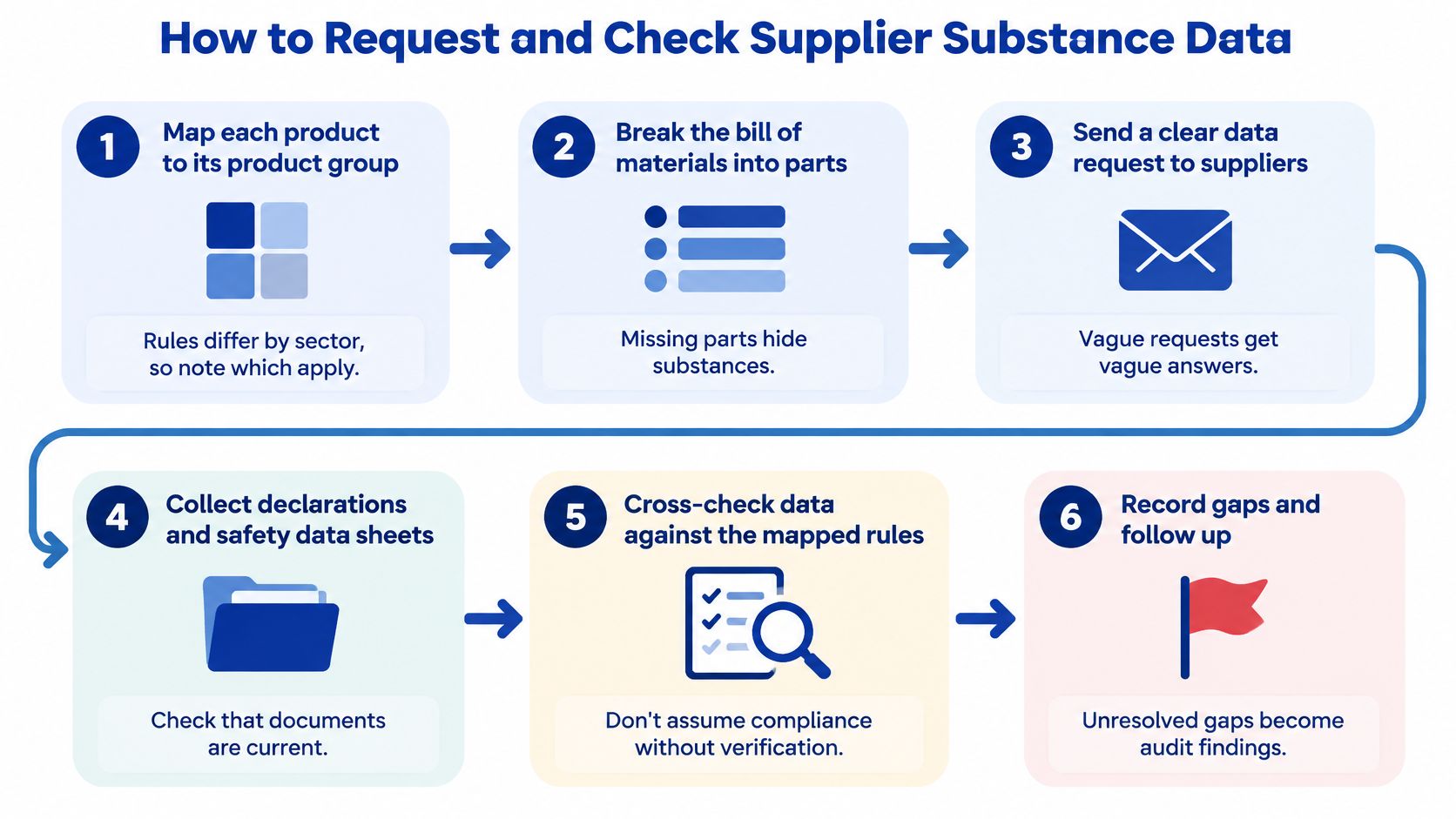
- Map each product to its product group. A jacket, a control board and a battery pack answer to different rules. Note which regime applies before you send anything.
- Break the bill of materials down to components. Substances sit in parts, coatings, adhesives and dyes. A part that never reaches the list never gets a data request.
- Assign each component to the supplier that owns it. The membrane supplier answers for the membrane. The garment assembler can't, and asking them wastes a quarter.
- Send a request with named fields and a date. Vague asks get vague answers. Ask for identity, concentration range, location, date and version, and stop there.
- Check each answer against the field list. A name without a concentration, or a concentration without a location, is a partial answer rather than a completed one.
- Check the evidence, not only the value. A declaration, a test report and a registration reference carry different weight. Compare the stated concentration with the threshold that applies to that substance.
- Approve, version and publish. Store the record against the revision it describes and release only the fields your access settings allow.
- Reopen the case on change. A new material, a new supplier or a new Candidate List entry makes the previous answer historical, not wrong.
Across a catalogue of hundreds of parts, the risk is losing track rather than lacking rules. Our supplier data requests, with review and approval, show which requests are open, which supplier owes which field and what's waiting for review.
The walkthrough below shows the same sequence in practice.
A workflow keeps the process visible. It doesn't decide which obligations apply to you, and that call stays with your legal or compliance team. More on how the supplier collaboration workflow fits together.
Handling Incomplete, Changing or Conflicting Substance Data
A supplier spreadsheet marked compliant may not show that the correct article, coating, colourway or component was assessed. In EU coordinated testing, 20% of 128 sampled consumer articles showed chemical non-compliance under REACH and/or POPs rules, with failures concentrated in PFAS-related substances in coated or waterproof textiles and restricted metals in inexpensive jewellery, according to the CASP 2025 activity report on chemicals. That's the difference between a document and evidence.
Five situations come up repeatedly. Each has a handling rule.
- No answer for one component. Publish the rest where the rules allow, hold the affected field and mark it incomplete. A visible gap is safer than a filled one you can't defend.
- Concentration given only as below a limit. Hold the record and ask for a range. Below a limit doesn't tell you which side of a threshold you're on.
- A substance added to the Candidate List after publication. Review the affected versions and republish with a new version where the field changes.
- A test result that contradicts a declaration. Escalate and don't publish until it's resolved. Two conflicting numbers in one passport is worse than one missing field.
- A supplier who can't disclose a full formulation. Accept documented evidence and restrict the sensitive field to parties with a legitimate interest or to authorities.
Where a passport stops: it improves transparency. It doesn't replace testing, technical documentation or market surveillance, and authorities remain responsible for checking that DPP data is accurate, complete and reliable.
Set your escalation rules for high-risk categories early: PFAS-treated textiles, plated metals, batteries and complex electronics. Confirm those rules with a legal or compliance adviser rather than improvising them mid-project.
Common Questions and Your Next Step
What if my product group has no delegated act yet
Collect the core fields now as internal records: identity, concentration and location, tied to the component and the revision. Mark each field's legal status, and check with your legal or compliance adviser before treating any field as mandatory.
Can I reuse a supplier declaration for a new model
Only if the component, the supplier and the revision all match. If any of the three changed, request a new declaration and version the record. Reuse is where stale data enters a catalogue.
Which fields can the public see
It depends on the field. Each one has one audience: the public, parties with a legitimate interest such as repairers and recyclers, or authorities. Composition and care information usually goes public; evidence and commercially sensitive formulation detail usually doesn't.
Where should I start this quarter
List your top ten products. For each, mark the components that may contain a substance of concern and name the supplier who owns each one. That list, not a policy document, is your starting inventory. Our field sets follow a common data core of identification, economic operator, materials, substances, circularity and evidence, so the same structure carries across product groups.
Is DPPWare a compliance tool
DPPWare is B2B software for Digital Product Passports, built and hosted in Germany with the data centre in Nuremberg. It holds one product record per model, batch or item, with supplier requests, field-level access, required-field checks, versioned publishing and QR-code passport pages. Textiles work out of the box; other industries are set up per customer project. It doesn't guarantee legal compliance and doesn't replace testing, certification or legal advice.
Before you book a demo, write a short description of your organisation, your product portfolio and your DPP requirements. We ask for those three things in every enquiry, because they decide which field set you'd start with.
Substance data only becomes useful when it belongs to a specific component, a specific revision and a named supplier, and that's the structure DPPWare gives you: one record per model, batch or item, supplier requests with review and approval, and field-level access for the public, legitimate-interest parties and authorities. When you're ready, visit DPPWare to see how the platform would handle your product groups, from textiles out of the box to a battery field set configured with your team.
This article explains regulations in general terms and is not legal advice. For a binding assessment of your products, check with your legal or compliance advisor.