Blog
Digital Product Passport Timeline: What Is Fixed in 2026
The digital product passport timeline doesn't support the common advice to prepare every product for a universal launch: a Digital Product Passport (DPP) obligation must be checked against the law covering the particular product. The practical distinction is between a fixed battery-passport deadline and other product-group requirements that need delegated acts before companies can establish their precise obligations.
Table of Contents
- Digital Product Passport Timeline at a Glance
- Framework Layer and Binding Dates
- The Battery Passport Deadline on 18 February 2027
- How to Prepare Product Data for Rules Still Being Written
- Product Granularity, Access and Personal Data Rules
- Frequently Asked Questions
- Request a DPPWare Demo for Your Product Data
Digital Product Passport Timeline at a Glance
A working-plan milestone isn't a compliance deadline. For planning purposes, separate legislation already in force, the battery-passport application date and the Commission's indicative timetable for developing other product-group rules.
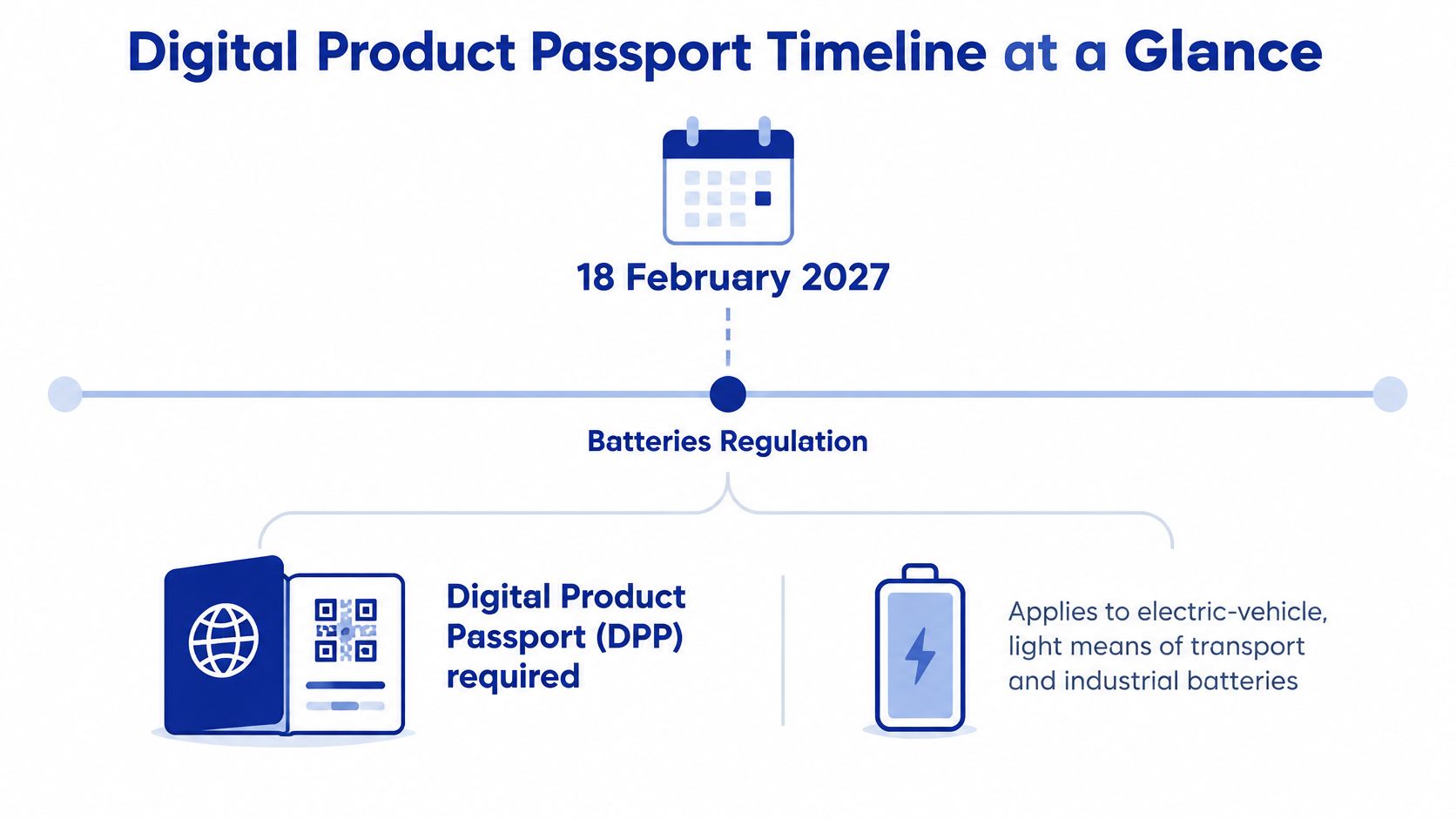
The framework is established by Regulation (EU) 2024/1781, the ESPR, which entered into force on 18 July 2024. The separate Batteries Regulation, Regulation (EU) 2023/1542, establishes the 18 February 2027 passport obligation for electric-vehicle batteries, light means of transport batteries and industrial batteries with a capacity greater than 2 kWh placed on the EU market or put into service.
The graphic highlights that battery milestone. The industrial-battery capacity threshold remains important when classifying products.
EU Digital Product Passport Milestones and Their Status
| Milestone | Date | Status |
|---|---|---|
| Batteries Regulation applies | 18 February 2024 | Fixed in law |
| ESPR enters into force | 18 July 2024 | Fixed in law |
| Producer-responsibility provisions identified in the implementation timetable | 18 August 2024 | Check the applicable provision and its application date |
| Iron and steel product-group rules | To be established through the delegated act | Working-plan priority, not a passport application date |
| Textiles, tyres and aluminium product-group rules | To be established through the relevant delegated acts | Working-plan priorities, not passport application dates |
| Battery passport mandatory for EV, LMT and industrial batteries above 2 kWh | 18 February 2027 | Fixed in law |
| Furniture product-group rules | To be established through the delegated act | Working-plan priority, not a passport application date |
| Mattresses product-group rules | To be established through the delegated act | Working-plan priority, not a passport application date |
| Transition period after each delegated act | Application timetable set by the applicable act | Check the adopted text before calculating a deadline |
The legislation linked above is the authority for the fixed dates. Don't convert an indicative adoption year into a launch date for your catalogue. For non-battery groups, record the application date only when the relevant legal text supports it.
If your team needs a common definition before assigning responsibilities, use this explanation of what a digital product passport is. Then mark the rows relevant to your products, name the person monitoring each legal development and leave unresolved application dates explicitly open.
Framework Layer and Binding Dates
An enacted framework doesn't mean every product immediately needs a passport. Think of ESPR as a building code, with each delegated act providing the room-by-room specification for a particular product group.
A passport is a structured digital product record reached through a data carrier such as a QR code. The framework establishes the regulatory approach, while product-specific rules determine what a particular record must contain and which products it covers.
The product groups shown below illustrate why a single company-wide countdown can be misleading.
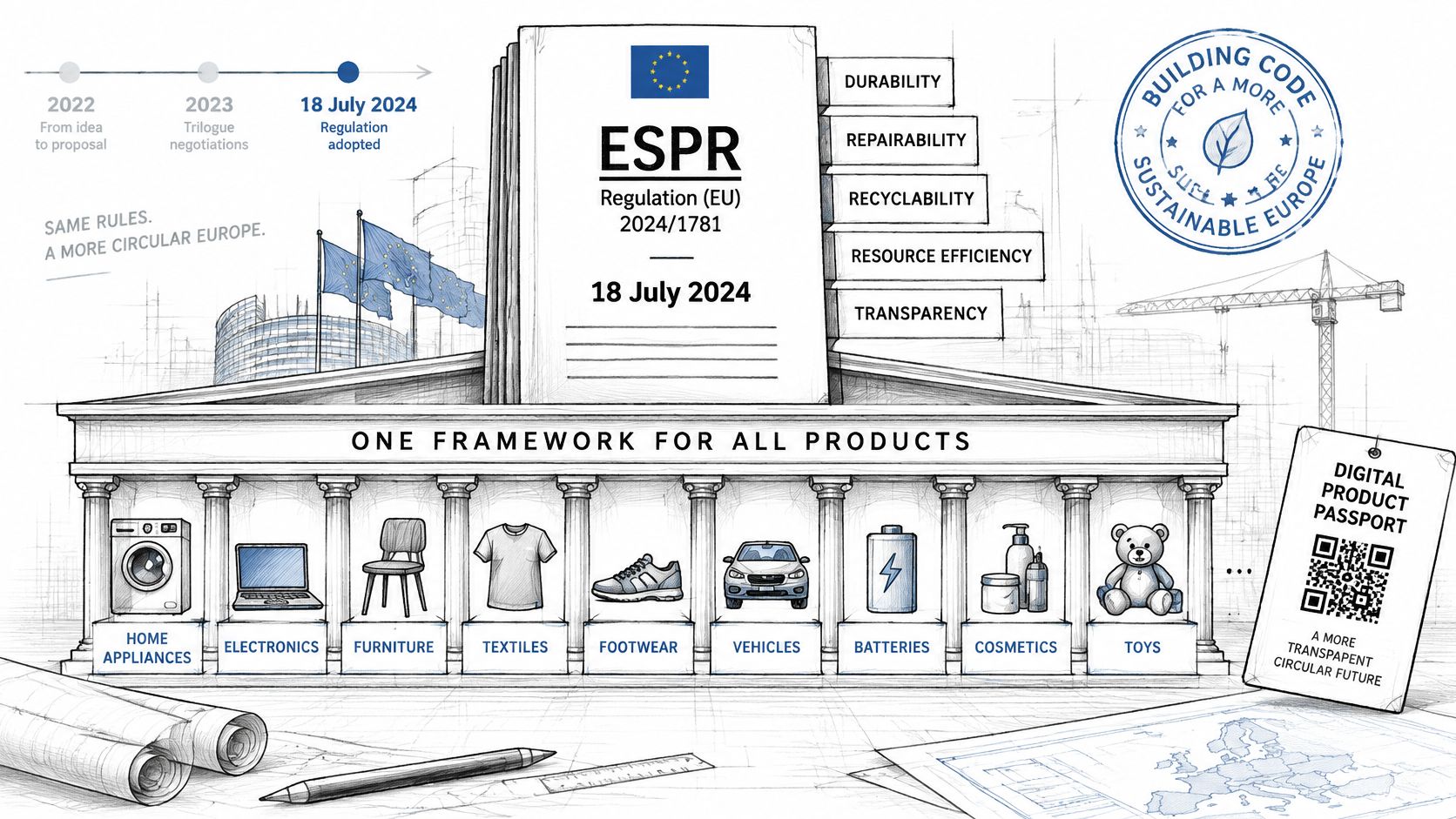
The European Parliament's ESPR procedure summary describes the framework for introducing product-specific requirements through delegated acts. The Commission's priorities include steel and aluminium, textiles and apparel, furniture, tyres and mattresses, alongside horizontal measures such as repairability and recycled content.
The European Commission's DPP overview distinguishes the developing product-specific rules from the established framework. That distinction matters more to a compliance calendar than a headline adoption year.
Four Timeline Events and Whether They Bind
| Event | What it means | Binding now? |
|---|---|---|
| Working-plan priority | Commission names a product group as a priority for delegated acts | No, inclusion alone sets no passport duty |
| Delegated-act adoption | Act establishes product-group requirements, including scope and passport specifications | The adopted text is authoritative, but application may follow later |
| Transition-period end | Operators reach the applicable implementation deadline | Check the act's application provisions |
| First placing-on-market date | Identifies when affected products must meet the applicable requirements | Set by the act, including any relevant transitional provisions |
| Battery-passport deadline | Separate passport obligation for the listed battery categories | Fixed by the Batteries Regulation |
Adoption and application are different legal events. An adopted act can settle the contents of a future obligation without requiring every affected product to meet those requirements immediately.
Nor should a compliance manager assume that the collection launch, factory completion date and first placing on the market are interchangeable. Record those commercial events separately, then ask the legal team which one the applicable provision uses.
Planning rule: Keep a legal milestone calendar and an operational delivery calendar. Connect them, but don't label an internal target as a statutory deadline.
Applying the Distinction to a Knitwear Collection
Say a knitwear brand is preparing a new collection. Before promising that the collection will carry legally compliant passports, its compliance manager should establish whether an applicable textile delegated act has been adopted, which products it covers and when its requirements apply.
The product-data manager can begin useful preparation without answering every legal question. Create stable model and variant identifiers, reconcile fibre-composition records and identify who can substantiate recycled-content claims.
Keep unresolved questions in the same planning register. For example, the brand may have reliable model-level composition but no agreed way to associate a supplier declaration with particular production batches.
A useful record distinguishes confirmed information, provisional field assumptions and legal questions awaiting an adopted text. Otherwise, a team can mistake a complete internal template for a complete regulatory specification.
This video provides supplementary context for the framework.
Keep Adjacent Obligations Separate
DPP preparation can involve the same teams that handle producer responsibility, but these obligations shouldn't share an undifferentiated deadline. For UK packaging responsibilities alongside EU product-data work, Packaging Panda's guide to who EPR applies to in 2026 is a separate scoping resource, not an authority for EU passport timing.
Use a short test for every product line:
- Priority status: Is the product group included in the Commission's working plan?
- Legal instrument: Has an applicable delegated act been adopted, and does its scope cover the product?
- Application provisions: What do the text's dates and transitional arrangements require for this product's market placement?
A legal or compliance advisor should confirm the binding interpretation. Supplier-data preparation can proceed alongside that review, rather than waiting for a final answer to every field-level question.
The Battery Passport Deadline on 18 February 2027
| Battery category | In scope from 18 February 2027? | Key check |
|---|---|---|
| Electric-vehicle battery | Yes | Confirm it is placed on the EU market or put into service |
| Light means of transport (LMT) battery | Yes | Confirm classification within the LMT category |
| Industrial battery above 2 kWh | Yes | Confirm capacity exceeds the threshold |
| Industrial battery at or below 2 kWh | No, outside this passport capacity threshold | Keep classification and capacity evidence |
| Other battery types | Not covered by this fixed passport obligation | Check other applicable battery requirements |
The scope above follows Article 77 of Regulation (EU) 2023/1542: from 18 February 2027, the listed batteries placed on the EU market or put into service require an electronic passport, including industrial batteries with capacity greater than 2 kWh. Falling outside that passport scope doesn't mean a battery is exempt from the regulation's other requirements.
Build More Than a Datasheet
The passport must accommodate battery-model information and information specific to the individual battery, including information resulting from its use. Article 77 and Annex XIII of the Batteries Regulation establish that content structure.
A product datasheet can provide shared technical characteristics, but it isn't a substitute for an individual-battery record. Separate shared specifications from instance-specific information so an update to an individual battery doesn't overwrite the model record.
Assign owners across the manufacturer, cell supplier, module supplier and material suppliers. Record which organisation supplies a value, who reviews it and which battery records it supports.
Test the Complete QR Chain
The consolidated Batteries Regulation connects the passport to the QR code under Article 13(6) and requires the responsible economic operator to upload the unique identifier to the registry established under Article 13(1) of ESPR.
Treat that as a sequence of checks:
- Responsible operator: Confirm who places the battery on the market or puts it into service.
- Identity: Associate the unique identifier with the correct battery record.
- Physical access: Place the QR code on or with the battery as the applicable provisions require.
- Registration: Confirm responsibility for uploading the identifier to the registry.
- Continuity: Test that a revised passport still resolves to the correct battery.
A successful QR scan proves that a destination opens. It doesn't prove that the record is complete, correctly classified or legally compliant.
In a controlled publishing workflow, users publish the passport, print the QR code and release a new version whenever the data changes. DPP software can support this sequence, but publishing functions don't replace legal review, certification or testing.
Use the EU Batteries Regulation guide to organise the wider implementation work. The immediate task is to classify each battery and confirm the responsible economic operator before designing its publication workflow.
How to Prepare Product Data for Rules Still Being Written
Don't wait for a final field list to discover that model identifiers, material descriptions and supplier references don't agree. The European Commission's guidance for economic operators describes a staged approach in which product-specific requirements develop through delegated acts.
That supports a practical distinction: prepare reusable data now, but keep provisional regulatory assumptions editable. A field can be operationally useful without yet being a confirmed legal requirement.
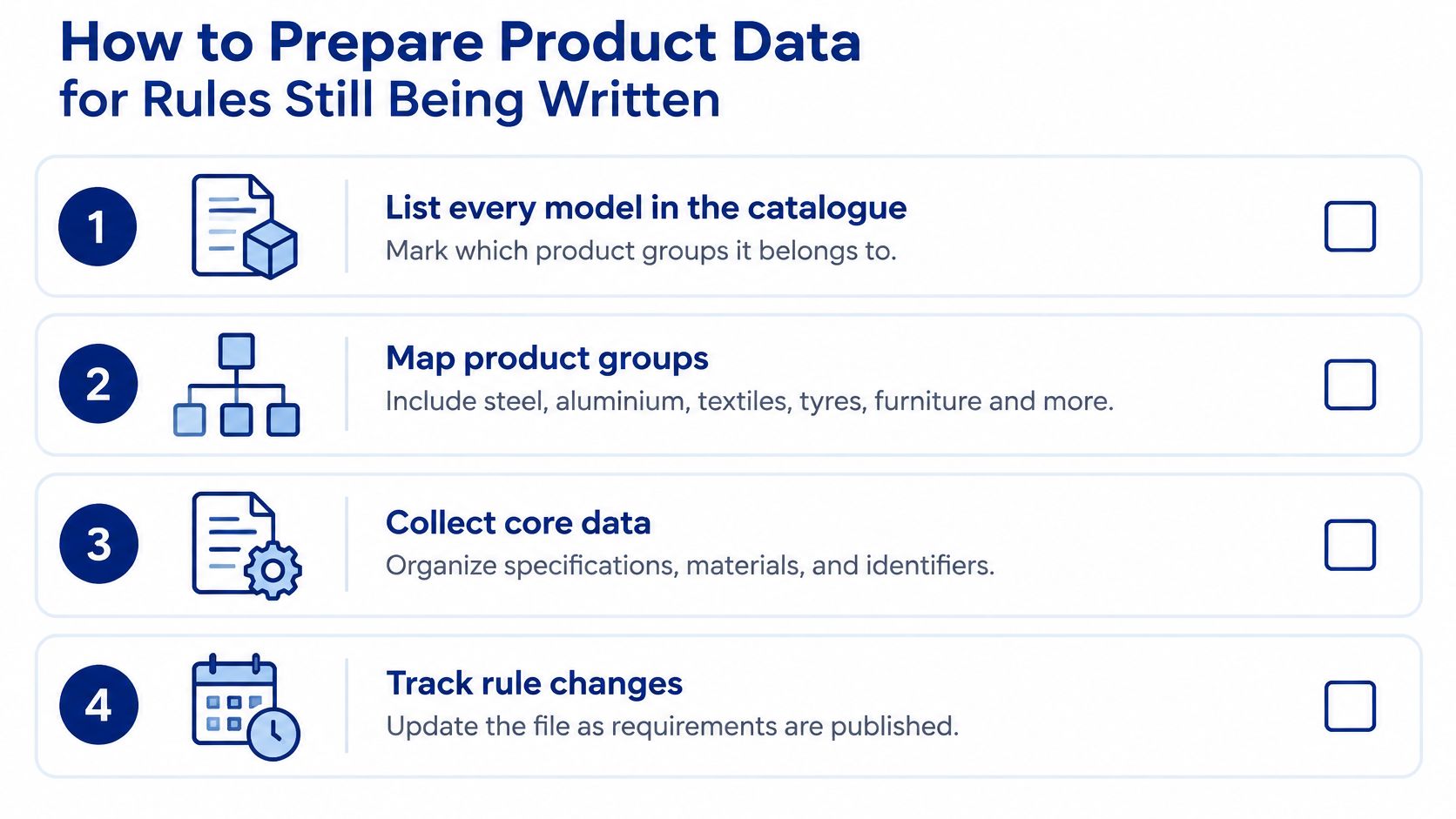
The preparation graphic provides a compact starting point.
A Routine Your Team Can Start This Week
List every model in the catalogue. Tag the relevant product groups, including steel, aluminium, textiles, tyres, furniture and mattresses. Use a classification register rather than assuming that every product sold under the same brand follows the same rules.
Establish model, batch and item relationships, starting with identifiers and materials. You don't need to assume the final mandatory granularity, but you should preserve the links that let a later requirement be implemented without reconstructing product history.
Assign an owner to each candidate field. For textiles, map fibre composition, substances, manufacturing locations and recycled-content evidence to the suppliers or internal teams able to substantiate them. An unanswered request needs a named follow-up owner, not just an empty cell.
Keep core identity data separate from product-group extensions. A new product group should add an appropriate field set rather than force your team to duplicate product identities across unrelated templates.
Review supplier answers before approval. Check units, identifiers, applicability and supporting references before transferring an answer into an approved record. A supplier collaboration platform can provide a structured collection process, but a reviewer still needs to resolve inconsistent answers.
Maintain an activity log and publish controlled versions. Record what changed and who approved the release so colleagues can distinguish a draft correction from information already published.
Re-run the field map whenever an applicable delegated act is adopted. Compare the legal requirements with your candidate fields, identify gaps and revise audience permissions before treating the record as ready for publication.
Measure Missing Information, Not Just Completed Records
For an additional Swedish-language perspective on organising product information, Glanser discusses hur Glanser ser på produktdatan. Use such operational explanations to inform your workflow, while relying on the applicable legal text for mandatory requirements.
Our first platform step is to create products with their identifiers and materials, then show which passport fields are still missing. That makes the initial exercise concrete: a team can distinguish a missing supplier answer from a missing internal approval.
Finish the routine with a readiness report. It should show unresolved fields, responsible owners and review status, rather than treating the existence of a QR page as evidence that the underlying work is complete.
Product Granularity, Access and Personal Data Rules
Granularity is a regulatory design decision, not merely a software setting. Under the ESPR, Regulation (EU) 2024/1781, passport data refers to the product model, batch or item as specified by the applicable delegated act adopted under Article 4.
That means a company shouldn't commit every product group to one universal passport structure. It should preserve the relationships between levels while allowing the applicable act to determine which level is required.
Passport Data Levels and Who May See Them
| Data level | Typical content | Who may need it |
|---|---|---|
| Model | Shared attributes, materials and technical specifications | Public users or authorities, according to the field |
| Batch | Production-run information and supplier lot details | Restricted audiences, according to the field |
| Item | Individual product or battery information, including use information | Legitimate-interest parties and authorities, according to the field |
| Customer personal data | Customer-identifying information | Exclude by default; assess the explicit-consent requirement before inclusion |
These are planning examples, not universal access permissions. Model data isn't automatically public, and item data isn't automatically restricted because it concerns an individual object.
The same ESPR text prohibits storing customer personal data in the passport without explicit consent in accordance with Article 6 of the GDPR. Don't add customer names, contact details or purchase records merely because an internal system makes them available.
Tag the Field, Not Just the Page
The European Commission's battery-passport guidance distinguishes information requirements and access audiences across technical, sustainability and circularity information. For battery preparation, assess repair, reuse and recycling information alongside technical characteristics rather than treating the passport as a consumer-facing marketing page.
Create a field catalogue that records the data level, proposed audience, owner and review status for each field. A repairer may need information that a general public page doesn't display, while authorities may require a different view.
Publication check: Review the public view and restricted views separately. Completeness and permission correctness are different checks.
Required-field checks can identify omissions, and versioned releases can preserve publication history. Neither decides whether a particular field belongs in the passport or which audience has a legal right to access it.
Have the responsible legal or compliance advisor review the catalogue before publication. The binding answer must come from the applicable rules, not from the default configuration of a software template.
Frequently Asked Questions
Is every product required to carry a passport at the battery deadline?
No. The fixed battery-passport obligation covers the specified battery categories, while other ESPR product-group requirements need their applicable delegated acts. A textile working-plan milestone shouldn't be entered into a compliance register as though it were an enforceable passport application date.
What if my product group has no delegated act yet?
Don't assign an ESPR passport deadline to that product solely because the framework exists. Monitor the relevant legal developments and prepare identifiers, material records and supplier ownership, while checking whether separate sector legislation creates obligations of its own.
Where do I find the binding text?
Use the EUR-Lex entries for ESPR and the Batteries Regulation linked above, together with the applicable delegated act once adopted. Check application provisions, amendments and transitional arrangements, and ask your legal or compliance advisor to confirm the interpretation for the actual product and economic operator.
Must every passport field be public?
No. Public information, information for parties with a legitimate interest and information for authorities need appropriate access arrangements under the applicable rules. A public QR destination doesn't mean that every underlying field should be visible to everyone who scans it.
Does DPP software make my products compliant?
No. Structured records, required-field checks and readiness reports support a controlled process, but they can't establish that a product meets every applicable legal requirement. For binding answers, use a legal or compliance advisor, and retain any required certification and testing processes.
Request a DPPWare Demo for Your Product Data
A useful demonstration starts with a sample of your catalogue, not an empty passport page. Bring model identifiers, material records and an example of a supplier-data gap so the discussion can focus on how your team would collect, review and publish information.
DPPWare is B2B passport software for manufacturers, brands and suppliers, built and hosted in Germany in a data centre in Nuremberg. It supports structured records per model, batch or item; supplier requests by link with review and approval; field-level access; required-field checks; versioned publishing; and QR-code passport pages.
Test the Workflow Against Your Own Records
Ask to see the readiness report, activity log and CSV export alongside the published page. Follow a supplier answer through review and approval, then check how the team fills each field, sets its audience and publishes a version once the required fields are complete.
Textiles work out of the box, including fibre composition, substances, durability and recycling information across collections. Other industries are configured per customer project, so the demonstration should distinguish the available textile setup from the field set needed for your product group.
The software doesn't guarantee compliance or replace legal advice, certification or testing. Confirm binding obligations with your legal or compliance advisor before treating a configured passport as a regulatory deliverable.
Visit DPPWare to request a demo using your own product data and inspect the records, readiness report and QR pages. Use the session to identify missing supplier information and publication controls for your timeline, then confirm the binding requirements with your legal or compliance advisor.
This article explains regulations in general terms and is not legal advice. For a binding assessment of your products, check with your legal or compliance advisor.