Blog
Battery Supply Chain Data for the EU Battery Passport
Most advice about the battery supply chain and the EU battery passport starts in the wrong place. It tells you to pick a platform, generate a QR code and populate the fields, as though the passport were a publishing task. The constraint that really decides whether you make the passport deadline isn't where the data is displayed. It's who can prove each value, in writing, on a date you can defend.
The Digital Product Passport (DPP) is a data-ownership and evidence problem long before it's a publication problem. Every field in the passport belongs to someone: a cell supplier, a module assembler, a material producer. Each value needs three things attached to it before it means anything. A named owner. An evidence status, meaning confirmed, estimated or missing. And a version, because values change as suppliers correct or refine them. Field lists and QR-code discussions skip all of this, which is why so many passport projects stall after the schema is agreed.
Get ownership right and publishing is a short final step. Get it wrong and the best-designed passport page sits in front of empty fields, with nobody able to say who owes what or by when.
Table of Contents
- The Battery Supply Chain From Mine to Pack
- Why Your Direct Supplier Holds Only Part of the Chain
- What the Battery Passport Requires and When It Applies
- The Data Each Stage Owns and Who Confirms It
- When the Data Arrives Estimated or Aggregated
- How to Set Up Supplier Data Collection Step by Step
- Frequently Asked Questions About the Battery Passport
The Battery Supply Chain From Mine to Pack
The battery supply chain runs from mined lithium, nickel, cobalt, graphite and manganese, through refining and chemical conversion, into active-material production, cell manufacturing, module and pack assembly, and finally collection, recycling and second life. Every one of those stages produces values the passport carries, and each value has exactly one party able to prove it.
That second point is what teams underestimate. A field list tells you what to publish. It says nothing about who signs off on the number, which document backs it, or what happens when a supplier revises it six months later. The table below sets out what happens at each stage, who a manufacturer usually deals with, and which passport-relevant values that stage holds.
| Stage | What happens | Typical actors | Data this stage holds |
|---|---|---|---|
| Mining and extraction | Lithium, nickel, cobalt, graphite, manganese and phosphate rock are extracted as ore or brine | Mines, brine operators, mineral traders | Mine or concession, country of extraction, quantities, chain-of-custody documents |
| Refining and chemical conversion | Ore or brine becomes battery-grade lithium salts, nickel and cobalt sulphate, purified phosphoric acid and manganese sulphate | Refiners and chemical plants | Processing location and plant, input and output mass balance, purity, batch reference |
| Active material production | Cathode active material for NMC and LFP chemistries, and anode active material from natural or synthetic graphite | CAM and AAM producers | Chemistry, grade, precursor source, recycled content share, energy and footprint values |
| Cell manufacturing | Electrodes, separator and electrolyte become cells; formation and ageing set performance | Cell makers | Cell model and capacity in kWh, performance and durability data, cell carbon footprint, test reports |
| Module and pack assembly | Cells are built into modules and packs with battery management system, housing and thermal parts | Module and pack assemblers, battery manufacturers | Pack identifier, serial numbers, configuration, repair and dismantling information, declaration data |
| Recycling and second life | End-of-life batteries are collected, dismantled and treated to recover metals | Collectors, recyclers, second-life integrators | Recycled content share, recycling efficiency, recovery rates, second-life status |
Where most manufacturers actually sit
Most manufacturers and importers reading this sit at pack assembly. They buy cells from one or two suppliers, buy a BMS and housing from another, and have no direct relationship with the refiner or cathode maker whose energy data underpins the carbon footprint. That gap is structural, and it dictates how evidence has to move: field by field, handed up through the chain of suppliers in between.
The uncomfortable part: the supplier who signs your purchase order often holds the cell specification but not the carbon-footprint or recycled-content value you have to publish.
The practical response is to treat every passport field as an owned item. Each value gets a named supplier owner, an evidence status (confirmed, estimated or missing) and a version with a date. A cell maker can confirm cell model, capacity and test reports directly, because it produced them. Recycled content of the cathode material belongs to the CAM producer, so the cell maker can only forward the request upstream or attest what it was told. Once you assign ownership this way, the table above stops being background reading and becomes a responsibility map.
The DPP is the record that ties these stages to a single identifier. For batteries the legal basis is the EU Battery Regulation, and the identifier has to connect a pack to the material, cell and recycling data behind it. A DPP does not create that data. It makes it visible, attributable and versioned, so a revised footprint figure replaces the old one instead of sitting next to it.
The far end of the chain matters more than many teams expect. Collectors, authorised dismantlers and recyclers hold the recovery evidence behind recycled-content claims, and practice varies widely by operator and jurisdiction. Outside the EU, operators work under different rules and documentation habits, as how Car Removals Whangarei handles packs illustrates for the New Zealand market. That variation is worth remembering when an imported pack arrives with an unclear history: the further the evidence has travelled, the harder it is to stand behind.
Take the table and mark two things: the stage where your own operations sit, and the stage where each of your tier-1 suppliers sits. The distance between them is the size of your data problem.
Why Your Direct Supplier Holds Only Part of the Chain
A tier-1 supplier list tells you who invoices you. It doesn't tell you who made the material, the active material or the cell inside the pack, and those are the parties holding the values the passport needs.
The production figures make the gap obvious.
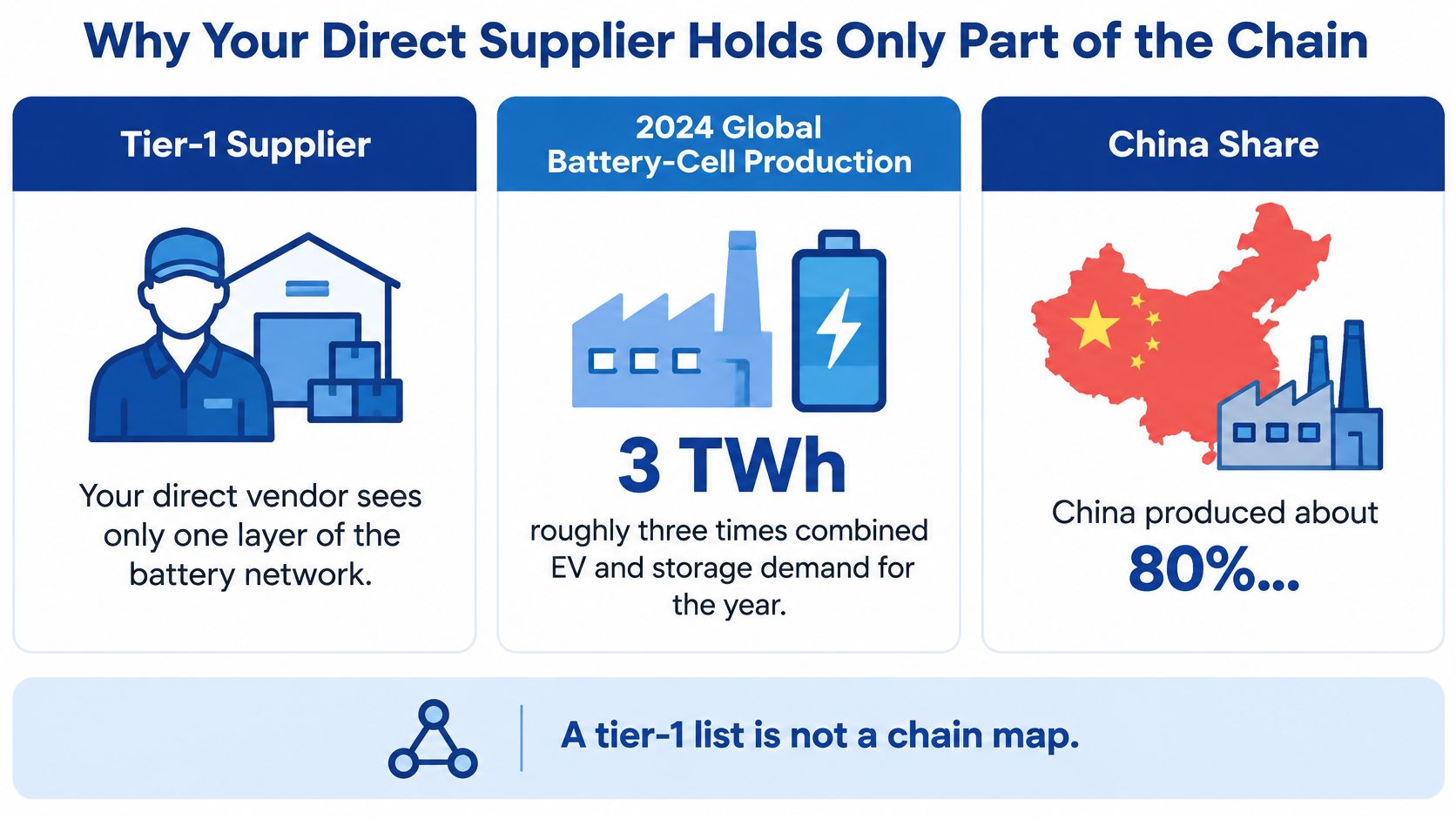
Global battery-cell production passed 3 TWh in 2024, growth of almost 30% in a single year and roughly three times the combined demand for electric vehicles and battery energy storage, according to the IEA Global EV Outlook 2025. China produced about 80% of the world's battery cells and held roughly 85% of global manufacturing capacity, with Chinese companies owning more than 75% of that capacity. Concentration continues into components: nearly 85% of cathode active material and more than 90% of anode active material came from China in 2024.
Chemistry changes what you ask for. In 2024-2025, more than 98% of LFP cathode material and LFP cells were made in China, against under two-thirds of nickel-based cathode material and about 60% of nickel-based cells. China also produced roughly three-quarters of global purified phosphoric acid, a key LFP input, and 95% of battery-grade manganese sulphate, per the IEA Global Critical Minerals Outlook 2025.
| Input | Share in China |
|---|---|
| LFP cathode material and LFP battery cells | more than 98% |
| Nickel-based cathode material | under two-thirds |
| Nickel-based battery cells | about 60% |
| Purified phosphoric acid (LFP input) | about three-quarters |
| Battery-grade manganese sulphate | 95% |
Four fields, not one
The conclusion that should change how you build supplier records: battery risk and missing information now sit in the midstream, in chemical conversion, active-material and cell production, not only in mining. A pack assembled in the EU can depend on several jurisdictions before it reaches the line.
Material origin, processing location, component producer and cell manufacturer are four separate fields. A single country-of-origin column collapses them into one value that misdescribes the chain, and every carbon or recycled-content calculation built on that column inherits the error.
If you're designing a supplier request now, ask for processing country and plant separately from the mine country. The two answers rarely match, and the mismatch is exactly what your evidence needs to record.
What the Battery Passport Requires and When It Applies
Two fields decide whether a battery is in scope: category and capacity. Classify the range before you design a field set, because EV, LMT and industrial batteries follow the same passport rule with different product realities behind them. A light vehicle pack, a stationary storage unit and an industrial battery may sit in different supplier chains, and the passport record has to reflect that from the start.
| Requirement | Applies to | Date and status | Legal basis |
|---|---|---|---|
| Battery passport | EV, LMT and industrial batteries above 2 kWh placed on the EU market or put into service | 18 February 2027, fixed in law | Regulation (EU) 2023/1542, Article 77(1) |
| Threshold case | Industrial battery of exactly 2 kWh, or any battery at or below the threshold | Outside Article 77(1); other obligations still apply | Regulation (EU) 2023/1542 |
| DPP for other product groups | Textiles, steel, furniture, electronics and others under a delegated act | Set by each delegated act | Regulation (EU) 2024/1781, Article 9 |
From 18 February 2027, every EV battery, LMT battery and industrial battery with a capacity greater than 2 kWh placed on the EU market or put into service must have an electronic battery passport. The rule sits in Article 77(1) of the EU Battery Regulation (EU) 2023/1542, and the threshold is strictly "greater than".
That wording matters at the boundary. A battery rated at exactly 2 kWh does not fall under Article 77(1) on capacity grounds, while other battery obligations may still apply. Confirm the rating and the market-placement status for each model before you assign a passport deadline in your product data.
What the passport field set covers
The regulation fixes scope and timing. The practical work sits in assembling the data behind the passport: values from cell, module and material suppliers, configured per project and checked before publication. That means the passport is a controlled product record with named data owners, not just a public page with a QR code.
Field lists help, but they leave three questions open for each value. Who owns it? What evidence supports it? Which version was published? A compliance team can have every field populated and still lack a defensible record if the carbon figure, recycled-content value or material declaration cannot be traced back to the supplier that supplied it.
Our Digital Product Passport timeline tracks milestones by product group, which helps when one team covers batteries and textiles at the same time.
Who is actually responsible
The responsible economic operator is the one placing the finished battery on the market, not each component supplier. That means the obligation lands on the manufacturer, brand or importer even when the underlying evidence is generated upstream by a refiner, active-material producer or cell maker.
A workable structure has two layers. The first layer contains published passport values. The second holds the working data used to calculate or substantiate those values, including supplier returns, calculation assumptions and review status. Keep both connected through versions, so a changed cell declaration does not leave an old value in circulation.
DPPWare is B2B Digital Product Passport software for manufacturers, brands and suppliers. The battery industry passport uses data from cell, module and material suppliers and is configured per project. Users can request specific fields by link, review returned data and approve it into the product record. Suppliers fill in the requested values without needing an account.
Confirm your product classification against the EUR-Lex text of Regulation (EU) 2023/1542 with your legal or compliance adviser before you commit a range to a launch plan. The regulation sets the obligation; your product data determines which models fall inside it and what evidence you can produce when the passport is published.
The Data Each Stage Owns and Who Confirms It
A field list copied from guidance tells you what to publish. It doesn't tell you who confirms the value, which is where battery programmes stall.
| Data area | What it covers | Which stage supplies it | Evidence to keep |
|---|---|---|---|
| Identification | Unique battery identifier, model, batch or item reference, manufacturer, category, capacity in kWh | Pack assembly, with cell maker input | Model and serial lists, technical file |
| Technical characteristics | Chemistry, voltage, capacity, energy density, materials used | Cell manufacturer and pack assembly | Cell datasheet, bill of materials |
| Carbon footprint | Value per declared unit, calculation method, reporting period | Cell manufacturer, supported by refiner and active-material energy data | Method and assumptions, energy mix, period covered |
| Recycled content | Shares of cobalt, lead, lithium and nickel recovered from waste | Recycler and refiner, declared by the pack manufacturer | Mass balance, supplier declarations, recovery evidence |
| Performance and durability | Capacity fade, cycle life, expected service life | Cell manufacturer and testing partner | Test reports and test conditions |
| Repair, reuse and dismantling | Spare parts, disassembly steps, safety instructions, second-life options | Pack design and assembly teams | Service documentation, dismantling manuals |
| Due diligence | Sourcing, processing and trading visibility for cobalt, lithium, nickel, natural graphite and secondary raw materials | Refiner and upstream chain, reported by the operator | Policies, audit reports, chain-of-custody documents |
| Substance and safety information | Hazardous substances, safety measures, transport classification | Cell and material suppliers | Safety data sheets, test reports |
The European Commission's guidance on the battery passport and the EU Digital Product Passport treats carbon footprint, recycled content and due diligence reporting as information that will form part of the passport. Its operational advice is the part worth copying: assign each field to the responsible supplier, record the reporting period and calculation methodology, retain approval status, and keep historical versions.
Three habits that keep the map usable
- Name a person, not a department. A department can't answer a query at four in the afternoon about a precursor plant; a named owner can.
- Attach a period and a method to every calculated value. A carbon figure without its reporting year and calculation approach is a number nobody can defend in a review.
- Keep status and history apart from the value itself. That's how a reviewer tells missing data from data that isn't applicable from data awaiting verification.
Practical rule: A field without a named owner is a field that will be missing in February 2027.
Structure and access
Under the ESPR, the passport is reached through a data carrier linked to a persistent unique product identifier. The carrier sits on the product, its packaging or its documentation as the delegated act specifies, and the data must be structured, machine-readable, searchable and transferable through an interoperable network without vendor lock-in, as set out in Regulation (EU) 2024/1781. The same act lets the delegated act decide whether a record describes a model, a batch or a single item.
Access splits into three groups: the public, parties with a legitimate interest such as repairers and recyclers, and authorities. Field-level access is the practical way to meet that split without publishing supplier-commercial terms into the open.
Due diligence is where requests stall most often, because the evidence is social and organisational rather than technical. If your scope includes labour and modern slavery risk alongside mineral origin, ESG Consulting's due diligence services cover that ground. Substance and safety data follows different logic again, which the guide to substances of concern sets out for the declarations that belong in the public layer and those that stay restricted.
Eight rows, one owner each. That fits on a single page and settles most arguments about scope.
When the Data Arrives Estimated or Aggregated
The standard advice is to wait until every supplier can return a clean, verified figure. Follow that advice and the programme finishes late, because the refiner three tiers up will not be digitally mature on your timetable.
Start collecting with the data you have and label it accurately.
Five statuses that make imperfect data usable
- Verified. A document or test report supports the value. This is the only status that can carry a precise published figure without a note.
- Supplier-declared. The supplier states the value in writing but hasn't shown you the underlying evidence. Publishable, with the declaration retained.
- Calculated. You derived it from a stated method and stated inputs. Publishable only with the method attached.
- Estimated. An informed guess or an industry average. It belongs in internal working files until evidence improves.
- Missing. Nobody has answered. Give it an owner and a date, not a blank cell.
Each status needs a remediation action, and only the first three should reach the public layer as precise numbers.
A chain-of-custody record isn't the same as a mass-balance claim, and neither proves mine-level provenance. OECD analysis cited in the European Commission's guidance note on preparing the digital battery passport reports that mapping material provenance to the mine remains difficult even where battery-tracking initiatives exist, and notes continuing implementation challenges.
What to record at each transformation point
Material identity changes at refining, at active-material production and at cell manufacturing. At each of those points, record the site, the batch reference, the input and output mass, and who performed the transformation. That's what lets a recycled-content share be correct for a batch without being traceable to one mine.
Say an LFP cathode supplier reports only a processing country. No plant, no precursor source, no batch reference. What you're holding is an aggregated supply-chain statement, not traceability. Publish the chemistry and the cell data you can verify, keep the origin claim at supplier-declared, and put the plant name and precursor source on the remediation list with a named owner.
Anything still at estimated six months before the deadline goes to management with a named owner and a decision attached, not onto a spreadsheet.
How to Set Up Supplier Data Collection Step by Step
The work is finite and unglamorous. Eight steps take a team from a product list to a published, evidenced record, and each one leaves an artefact you can show to management.
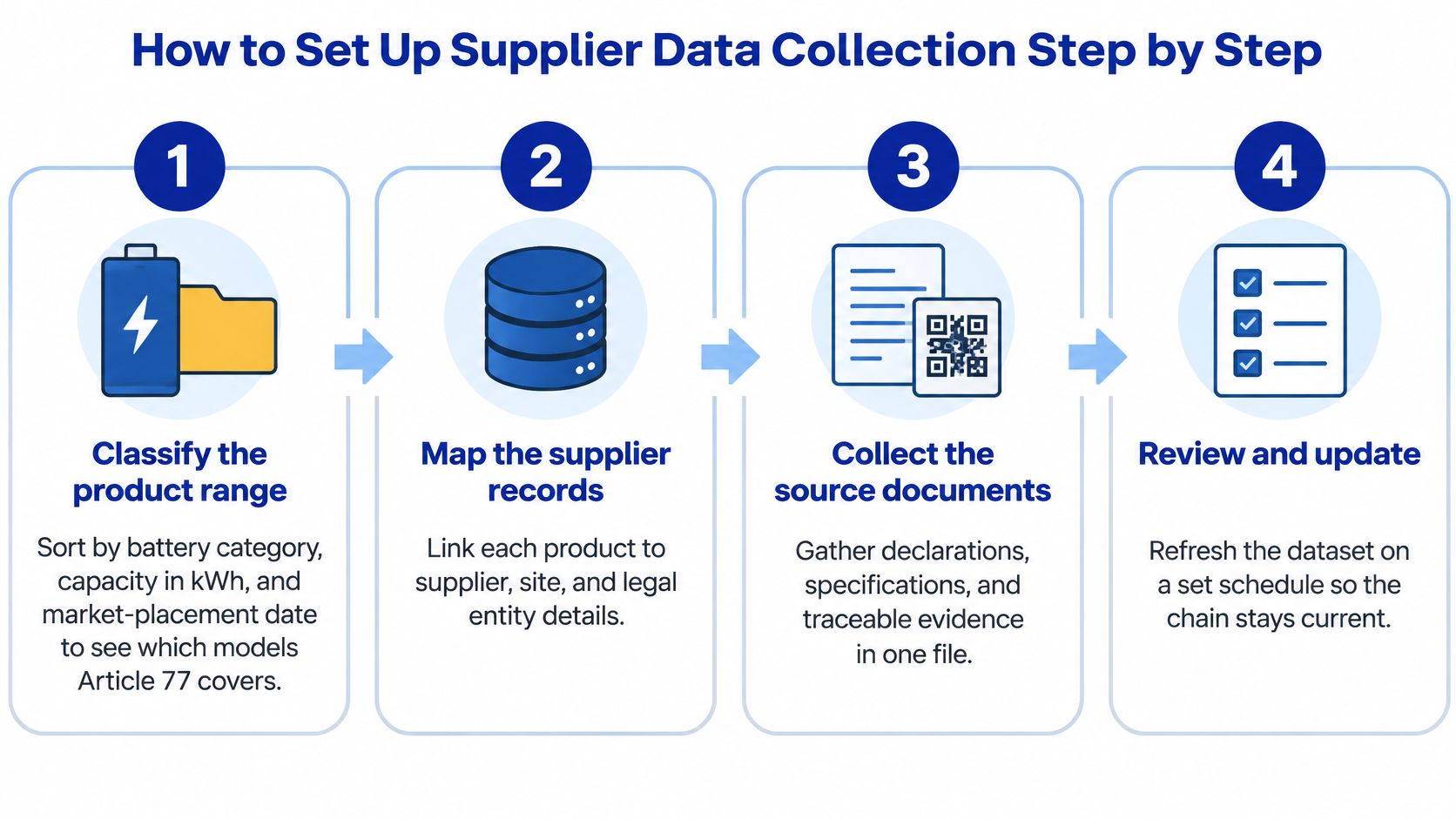
- Classify the range by category, capacity and market-placement date. List every model with its battery category, its capacity in kWh and the date it enters the EU market. The result is a scope list showing which models fall under Article 77 and which fall outside it.
- Fix the field register. For each data area, write the fields you'll collect and mark each one mandatory, optional, conditional or calculated. That register is the document your suppliers will see, so keep the wording plain.
- Map one representative battery actor by actor. Take a single pack and walk from refiner to pack assembler, with material origin and processing location in separate columns. One real chain map teaches more than a template, and it exposes the questions your request can't yet answer.
- Name two owners per field. One internal, one external. The internal owner chases, the external owner certifies. Write both into an owner matrix, because a field with one name on it gets followed up and a field with none doesn't.
- Send field-specific requests. State the unit, the reporting period, the calculation method and the evidence format you need, and ask only for the fields that supplier owns. A request that includes everything gets answered with estimates. DPPWare turns this into a link per supplier, the supplier completes the fields it owns without needing an account, and you approve or query each value before it enters the record. What comes out is a request log.
- Review returns against the register. Query anything missing a method or a period rather than accepting it. Every accept-or-query decision lands in an approval log, which is the file that answers a reviewer's question eighteen months later.
- Publish the checked public layer and version it. Run required-field checks before release and keep the previous version intact, so an improvement in evidence shows as a new version rather than a silent edit.
- Keep a remediation list and review it monthly. Sort by status and by deadline, not by supplier name. That list is your open-items register until the obligation applies.
If you'd rather see the mechanics of request, review and approval before you build the register, this walkthrough covers the sequence:
The supplier collaboration platform overview explains how the request, review and approval loop fits together when several tiers answer at different speeds. The same sequence works in every industry: create the product, request data from suppliers, review what comes back, publish and maintain.
Frequently Asked Questions About the Battery Passport
Does an industrial battery of exactly 2 kWh need a passport under Article 77
No. The threshold is greater than 2 kWh, so a battery at exactly 2 kWh falls outside that specific requirement.
Other obligations under the regulation still apply, so confirm the classification with your legal or compliance advisor before you exclude it from a project plan.
When do other product groups need an ESPR passport
Only when a delegated act for that product group sets the requirement. No date is fixed for textiles, steel, furniture or electronics today.
Any specific date quoted for those groups deserves checking against the delegated act itself.
Is passport data public
Not all of it. Access splits between the public, parties with a legitimate interest such as repairers and recyclers, and authorities.
Field-level access is what keeps commercial supplier terms out of the public layer while leaving the record traceable for the other two groups.
Is the QR code the passport
No. The QR code is the data carrier. The record, its versions and its evidence sit behind it, and the delegated act decides whether the identifier points to a model, a batch or a single item.
What if a supplier returns an estimate
Give it a status, an owner and a deadline, and don't publish it as a precise figure. An estimated value stays on the remediation list until evidence moves it up to declared, calculated or verified.
If you want to see how this works on a real product, bring one battery model and its supplier list to a demo, since battery field sets are configured per customer project rather than switched on from a template.
DPPWare is B2B software for Digital Product Passports, built and hosted in Germany, with one product record per model, batch or item, supplier requests sent by link with review and approval before values enter the record, and field-level access for the public, legitimate-interest parties and authorities. For a battery programme it gives you a single view of which supplier owes which value, which fields are still open, and what changed between published versions, with QR-code passport pages and readiness reports on top. Visit DPPWare to see how a battery field set would be configured for your products and suppliers.
This article explains regulations in general terms and is not legal advice. For a binding assessment of your products, check with your legal or compliance advisor.