One platform. Every product.
Digital Product Passport software, made and hosted in Germany.
Manage product information, collaborate with suppliers and create Digital Product Passports across industries with one scalable platform.
DPP · 4012345678901
32Fields per textile passport
Three audiences per field
Public23
Legitimate interest4
Authorities5
Passport publishedBasic T-shirt · v3
Built around open standards and EU rules
- ESPR 2024/1781
- GTIN
- QR
- CSV
Industries
Built for multiple product industries
One architecture, configurable data. Each industry has its own legal basis and timetable, so each has its own field set.
- Textiles & FashionFibre composition, substances, durability and recycling data across collections.Available
- BatteriesBattery passport data from cell, module and material suppliers.Configured per project
- Electronics & Electrical EquipmentComponent, repair and substance data for devices and equipment.Configured per project
- Furniture & Interior ProductsMaterials, components, spare parts and disassembly per product.Configured per project
- Construction & Building MaterialsPerformance, environmental and safety data per product family.Configured per project
- Steel, Aluminium & MetalsBatch-level data on grade, recycled content and carbon footprint.Configured per project
- Tyres & Automotive ComponentsMaterial, recycled-content and dismantling data for tyres and parts.Configured per project
- Packaging & Packaged ProductsMaterial, recyclability and recycled-content data per packaging component.Configured per project
Deadlines
When does a product passport become mandatory?
One product group has a date fixed in law. For the others the European Commission has named indicative years, or the timing is still open.
- BatteriesBinding
98days left
From 18 February 2027
Electric-vehicle batteries, batteries for light means of transport and industrial batteries above 2 kWh.
Batteries Regulation (EU) 2023/1542
- Steel, Aluminium & MetalsNo legal date yetIndicative: 2026 for iron and steel, 2027 for aluminium.Indicative
- Textiles & FashionNo legal date yetAct indicatively expected in 2027.Indicative
- Tyres & Automotive ComponentsNo single dateTraction batteries from 18 February 2027. Tyres indicatively 2027. Vehicle passport after a transition period.Mixed
- Furniture & Interior ProductsNo legal date yetIndicative: 2028 for furniture, 2029 for mattresses.Indicative
- Construction & Building MaterialsNo single dateIntroduced product family by product family.Step by step
- Packaging & Packaged ProductsNo product passport as suchThe regulation applies since 12 August 2026: information and labelling duties.In application
- Electronics & Electrical EquipmentNo legal date yetNo act adopted. Timing is open.Open
Last reviewed: 11 November 2026. This overview is general information, not legal advice. Check the current legal texts on EUR-Lex for your products.
Functions
From product record to published passport
Centralise product information, collect supplier data and publish Digital Product Passports across your product portfolio.
- Available
Product data management
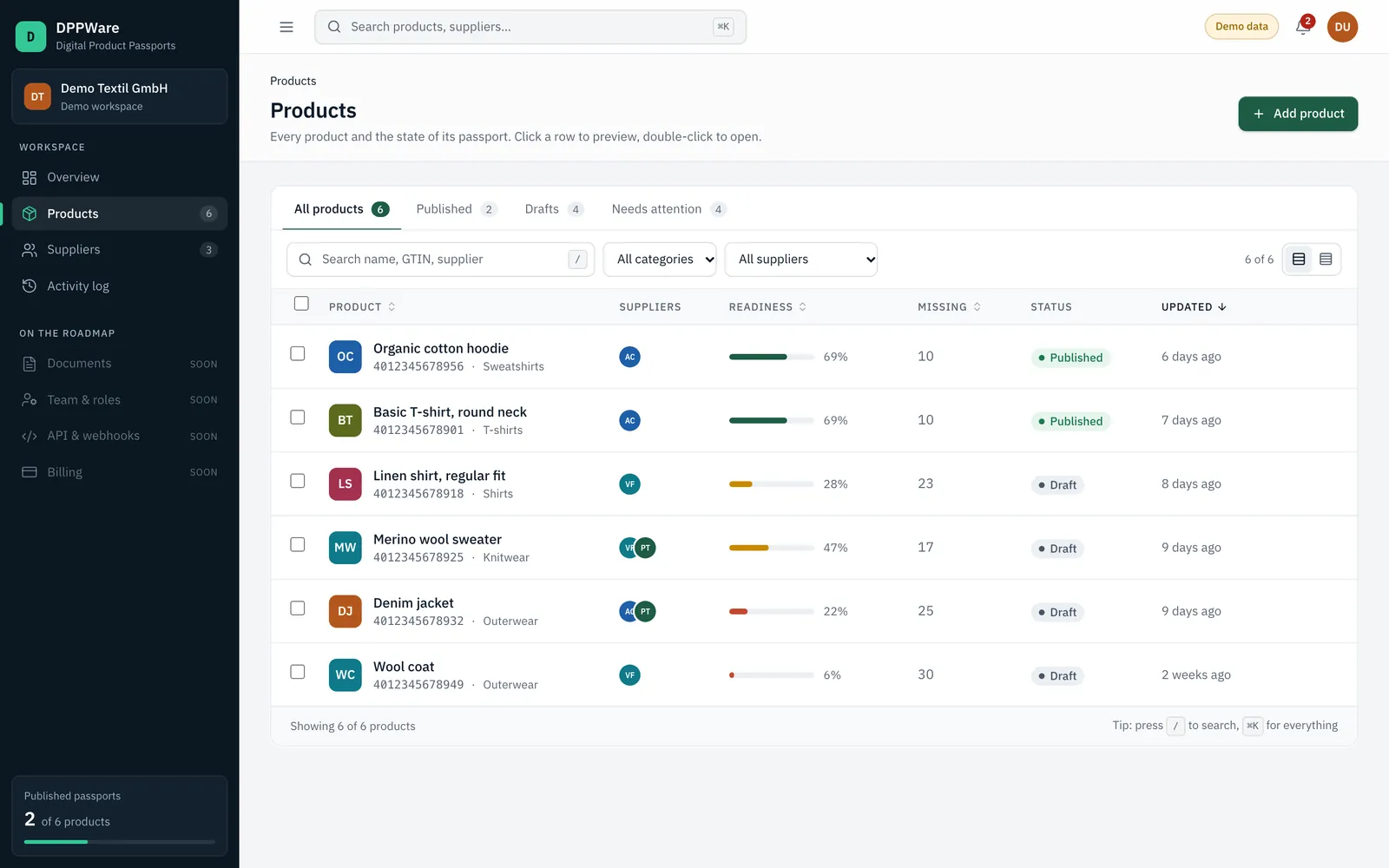
One record per product with identifiers, materials, suppliers and completeness per section.
- Available
Digital Product Passport creation
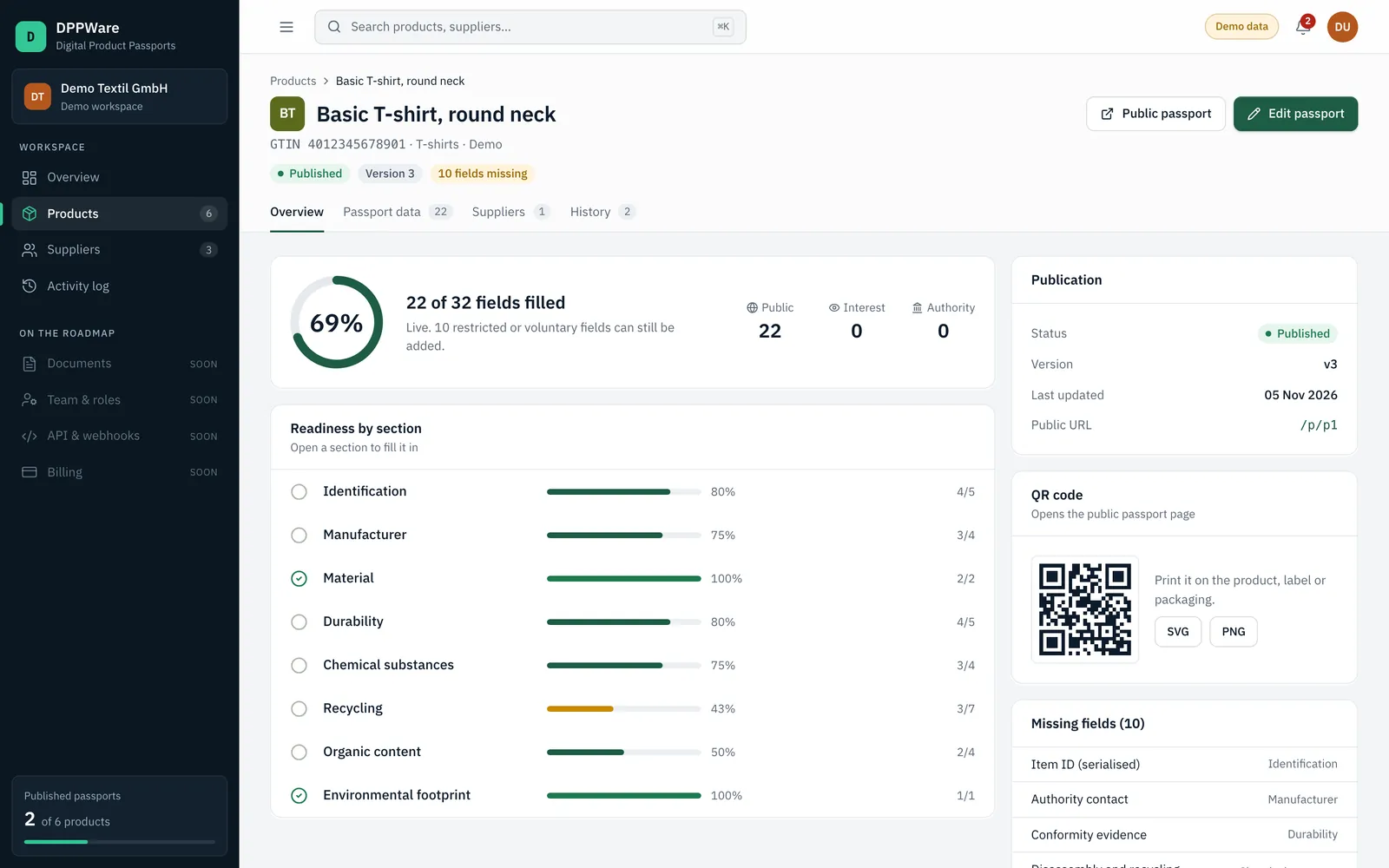
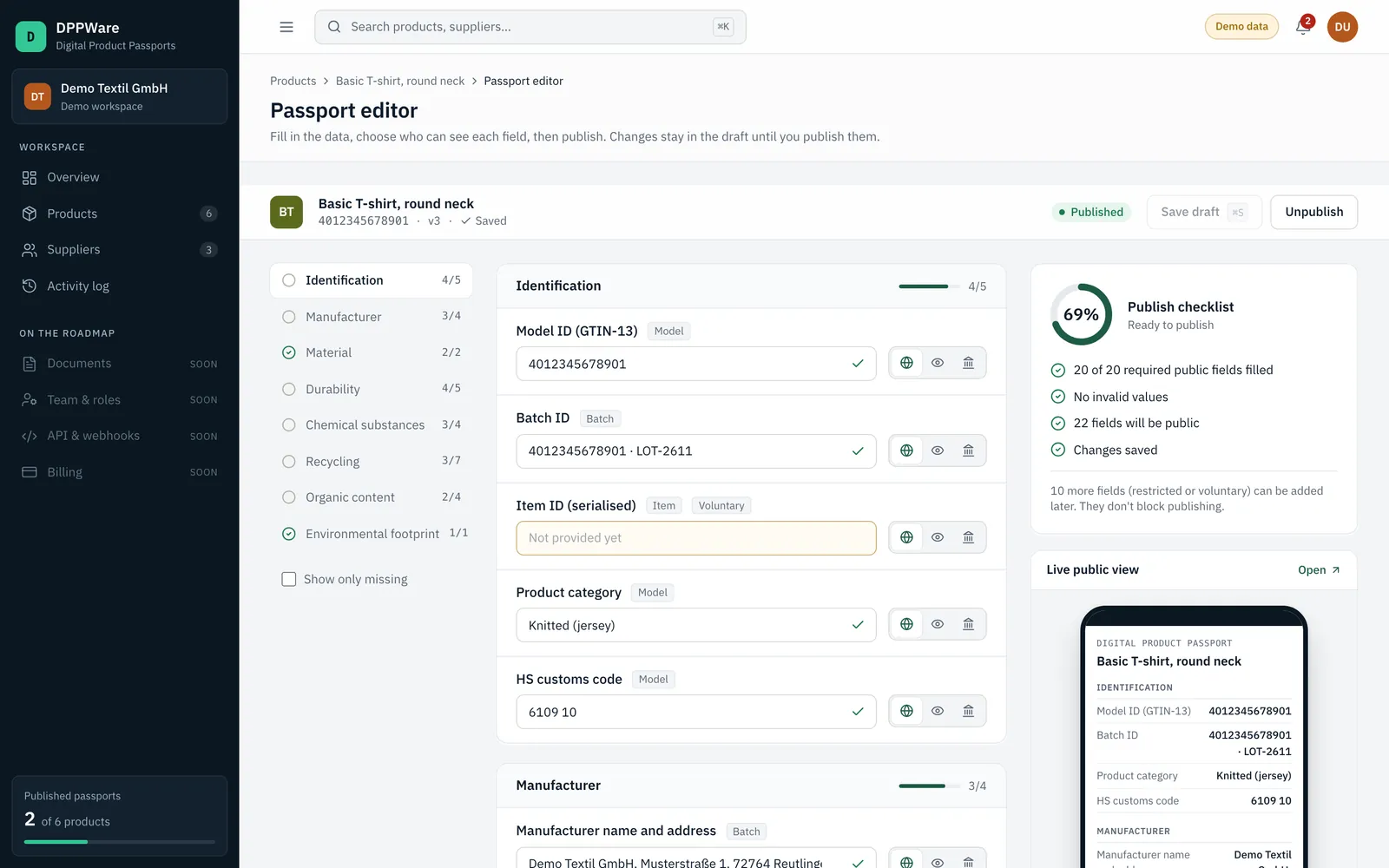
Fill each field, set who may see it and publish a versioned passport once the required fields are complete.
- Available
Supplier collaboration
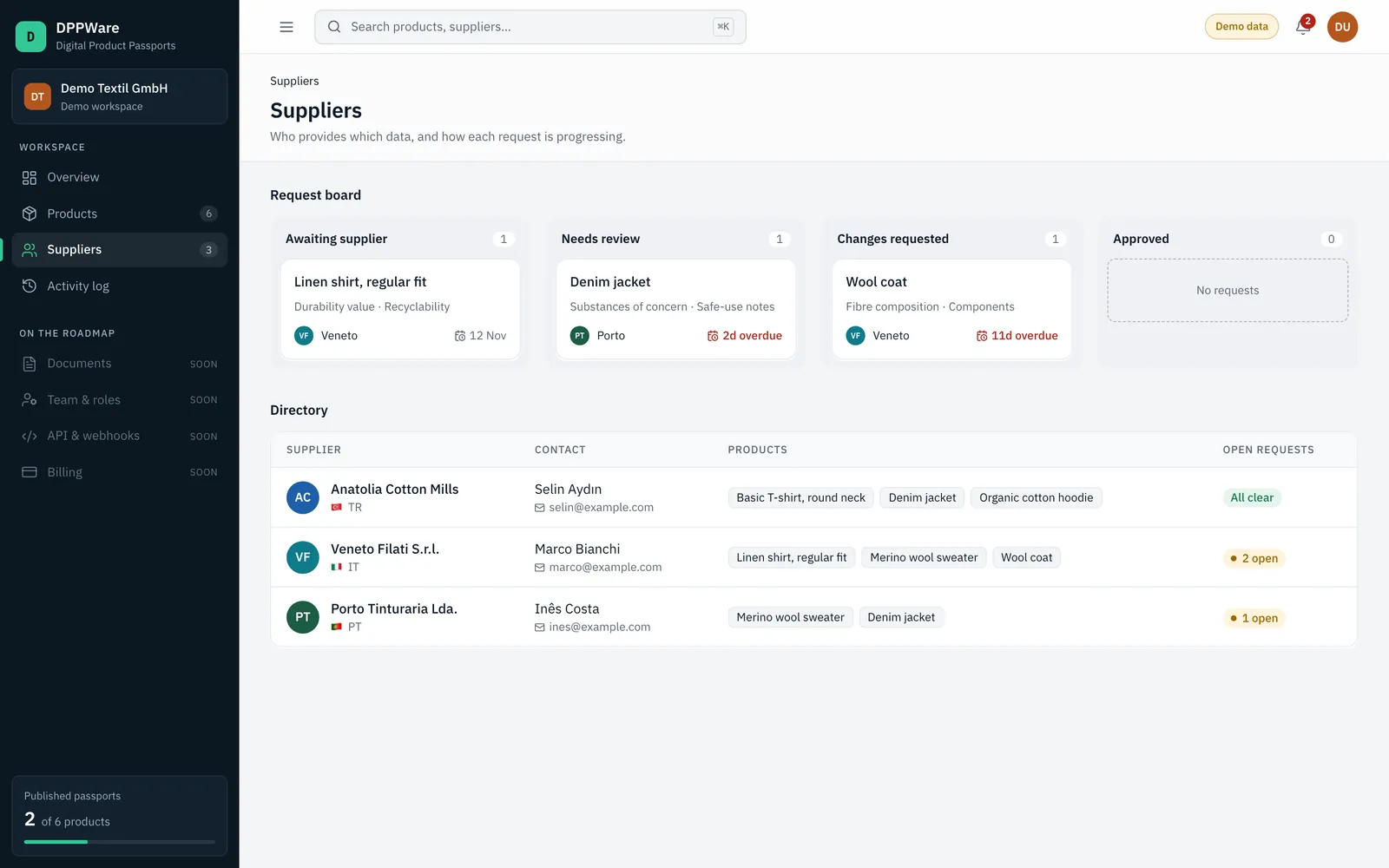
Request specific fields from a supplier by link, review what comes back and approve it into the product record.
- Planned
Product documentation
Certificates and test reports stored with the product and released only to the right audience.
- Available
QR code and passport publishing
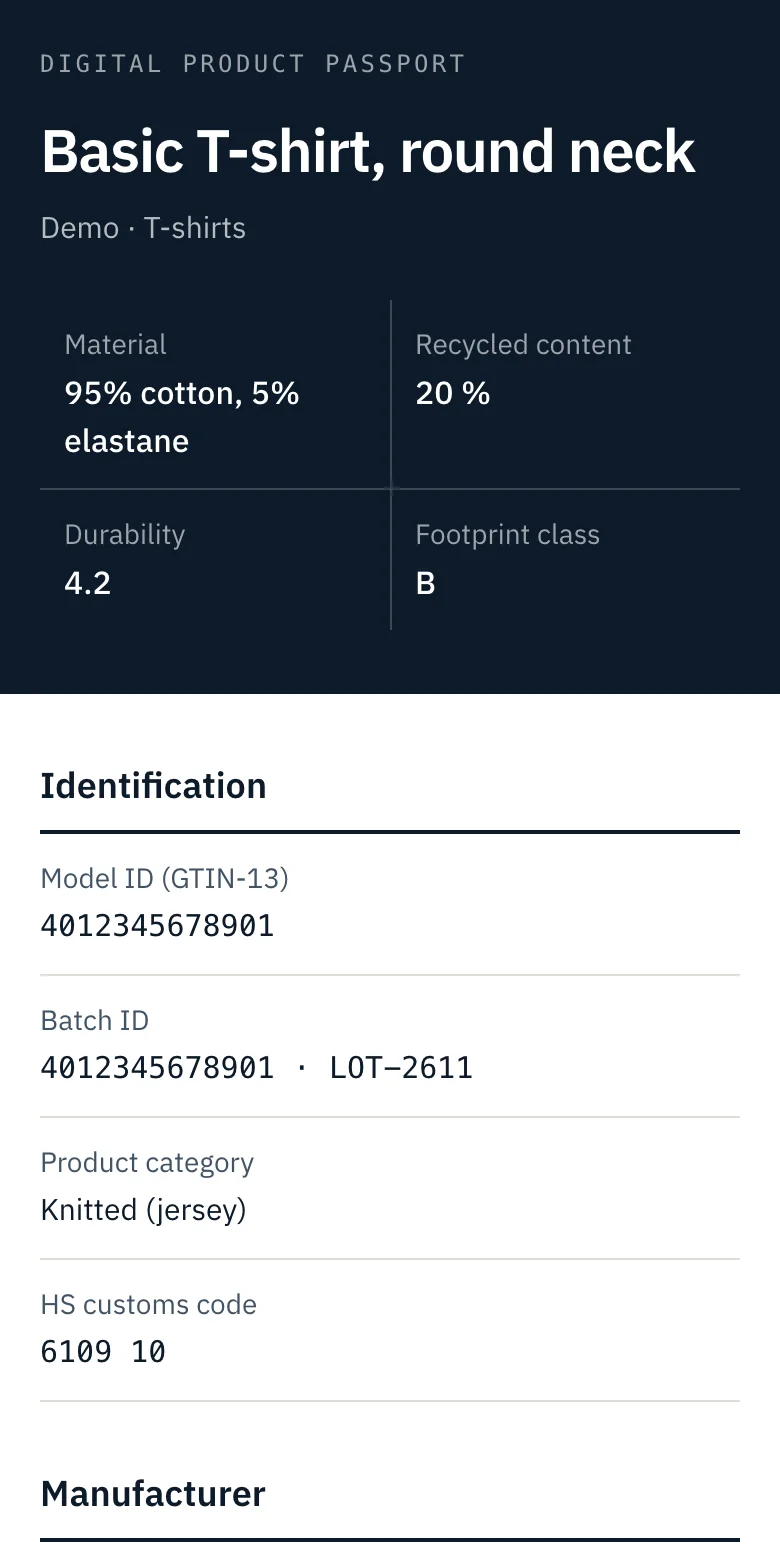
Every published passport has a public page and a QR code to print on the product, label or packaging.
- Planned
API and integrations
Exchange product data with ERP, PIM and shop systems.
Available: works in the application today. Configured per project: set up together with you. Planned: on the roadmap, not delivered yet.
Process
How it works
Set up your product data
Create products with their identifiers and materials. The platform shows which passport fields are still missing.
Collect what suppliers hold
Send a request for exactly the fields a supplier owns. Submitted data waits for your review before it is used.
Publish and maintain
Publish the passport, print the QR code and release a new version whenever the data changes.
Product
The application, as it is today
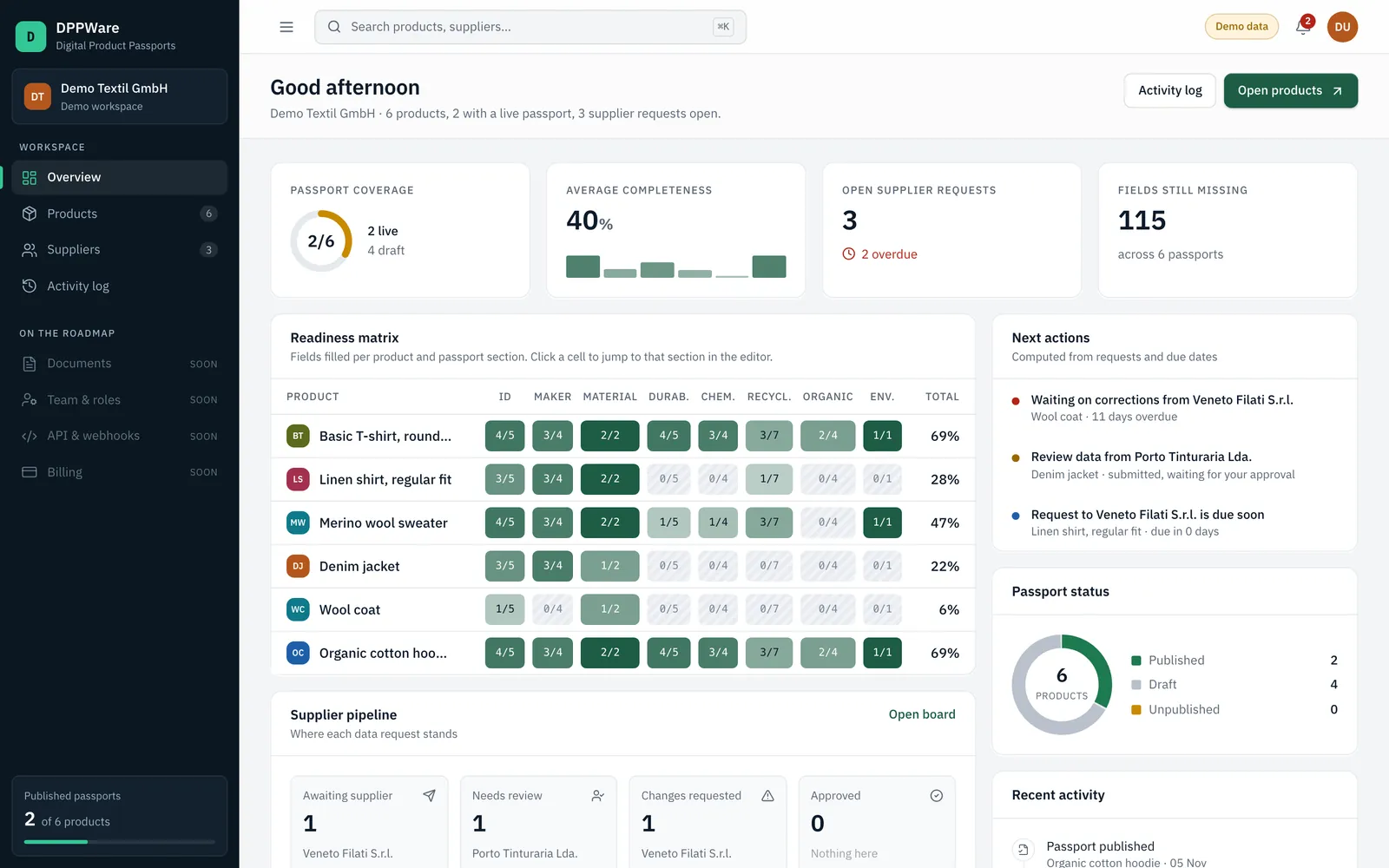
No mock-ups. These are screenshots of the working application with sample data.
Benefits
Made for organisations with many products and many suppliers
Support your organisation in preparing and managing product information for applicable Digital Product Passport requirements.
- One structure across industries
- Fields, sections and audiences are data, not code. A new product group is a new field set, not a new system.
- Control over disclosure
- Each field is released to the public, to parties with a legitimate interest or to authorities only.
- Traceable changes
- Every publication creates a version, and every action is written to an activity log.
- Clear responsibility
- You see which supplier owes which data, by when, and what is waiting for your review.
- An honest roadmap
- Each function is labelled as available, configured per project or planned. You know what you are buying.
Ready to manage your product data more effectively?
Tell us about your organisation, product portfolio and DPP requirements.
Model, batch and item level
Three audiences per field
Versioned publication
Hosted in Germany