Blog
What Is a Digital Product Passport? EU Rules and Steps
What is a Digital Product Passport, and why does the honest answer depend on which product you're holding? You might expect one definition, one data set and one deadline. You get the definition, then a queue of product-specific rules, only one of which has a date fixed in law.
The gap between those two things is where most planning goes wrong, in both directions: teams wait for a date that doesn't exist, or they build against a year that was never a deadline. This walkthrough separates what's settled from what's still open, in the order a product-data manager has to deal with it.
Table of Contents
- What a Digital Product Passport Is
- EU Rules and Deadlines for Digital Product Passports
- What a Passport Record Contains
- Who Can See Which Passport Data
- Preparing a Battery Passport
- How to Prepare Product and Supplier Data
- Frequently Asked Questions About Digital Product Passports
- Confirm Your Scope and Request a Demo
What a Digital Product Passport Is
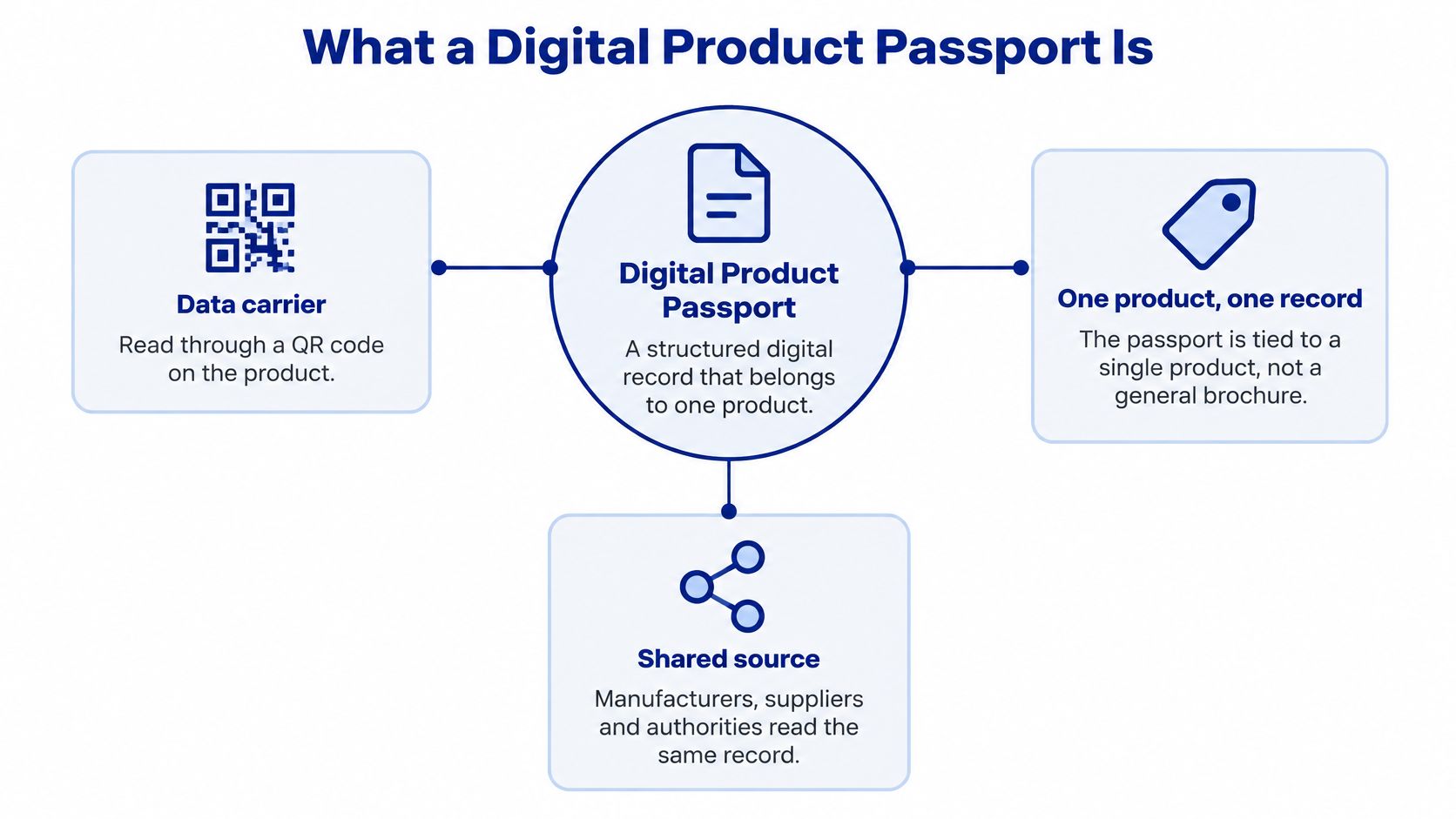
A Digital Product Passport (DPP) is a product-specific set of data that a business publishes in structured electronic form and links to a physical product through a data carrier, usually a QR code. The EU text defines it as the data required by the applicable delegated act, reachable electronically through a data carrier such as a QR code, and it adds a condition that shapes every later decision: the data must be accurate, complete and up to date (Regulation (EU) 2024/1781 as published in the Official Journal).
The closest everyday comparison is a car's service logbook. It travels with the vehicle, records who did what and when, and stays useful to a buyer, a mechanic and an inspector. A DPP works the same way with two differences. It's structured so software can read it, not only people. And each reader sees only the sections they're entitled to see.
Three layers to keep apart
Almost every muddle comes from mixing these up.
- The data. What the passport must contain for that product group: identifiers, materials, substances, repair information, end-of-life instructions.
- The access rules. Which fields are public, which are open to repairers and recyclers, which are open to authorities.
- The publication process. Who approves a change, when a new version replaces an old one, and how the record stays true over the product's life.
A team that treats the passport as a web page gets the third layer wrong first. A team that treats it as a data project handles all three in the right order.
Two terms worth pinning down
An economic operator is the manufacturer, importer or other business placing the product on the EU market. The obligation usually lands there, not on a component supplier three tiers upstream.
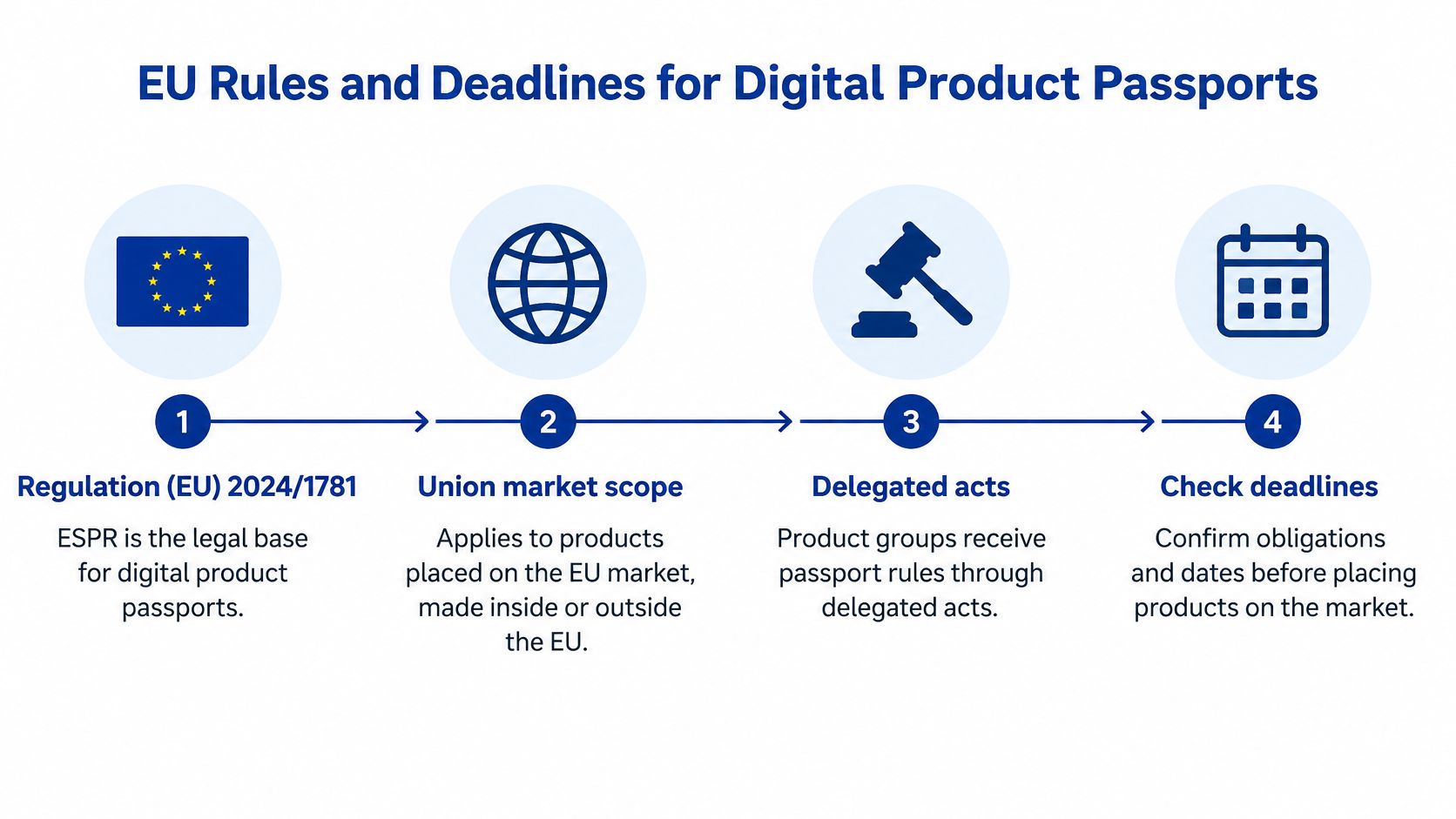
A delegated act is a rule the European Commission adopts to set requirements for one product group. It decides the field list, the granularity and the date the rules apply.
A test you can run on your own catalogue
Sort your products into two piles. In the first, everything whose product group already has rules: batteries are the live example. In the second, everything waiting for its delegated act, which today means textiles, furniture, steel and the rest. Only the first pile carries a date you can plan against. The second pile rewards preparation, not deadline-chasing.
Confusion at this stage is ordinary. In a representative autumn 2024 survey of 1,078 German companies, 38% said they were unaware of Digital Product Passports and 27% said DPPs were not relevant to their business, according to the German Economic Institute (IW).
EU Rules and Deadlines for Digital Product Passports
The legal foundation is the Ecodesign for Sustainable Products Regulation (ESPR), Regulation (EU) 2024/1781. It covers products placed on the Union market whether they are manufactured inside or outside the EU, so an importer bringing goods in from a third country carries obligations alongside the manufacturer. The Commission describes the requirements as arriving progressively, product group by product group (European Commission, Digital Product Passport).
The one date fixed in law
One deadline already sits in binding text. Regulation (EU) 2023/1542 obliges every electric-vehicle battery, every light means of transport (LMT) battery and every industrial battery with a capacity above 2 kWh placed on the EU market or put into service to carry an electronic battery passport from 18 February 2027. That date comes from the Battery Regulation rather than ESPR, and it is the only DPP deadline currently written into EU law. Everything else on the timeline is still waiting for its own act.
Why the other rows are planning estimates
The Commission's first ESPR working plan sets indicative priorities: iron and steel in 2026, energy-related products from 2026 to 2029, textiles, tyres and aluminium in 2027, furniture in 2028, and mattresses plus information-and-communications-technology products in 2029. Treat those years as drafting priorities only. An obligation begins once the delegated act for that group is adopted, and adoption starts a transition period of at least 18 months before the rules apply. Packaging, construction products and critical raw materials follow separate legislation again.
| Product group | Legal basis | Status and timing |
|---|---|---|
| Batteries: EV, light means of transport and industrial above 2 kWh | Regulation (EU) 2023/1542 | Fixed in law: passport required from 18 February 2027 |
| Iron and steel | ESPR delegated act still to come | Indicative priority 2026; no legal date |
| Energy-related products | ESPR delegated act still to come | Indicative priority 2026 to 2029; no legal date |
| Textiles | ESPR delegated act still to come | Indicative priority 2027; no legal date |
| Tyres and aluminium | ESPR delegated act still to come | Indicative priority 2027; no legal date |
| Furniture | ESPR delegated act still to come | Indicative priority 2028; no legal date |
| Mattresses and ICT products | ESPR delegated act still to come | Indicative priority 2029; no legal date |
| Packaging, construction products, critical raw materials | Separate legislation | Timing set by that legislation; no date to rely on yet |
| Other product groups | ESPR delegated act still to come | Timing set by the act; no date to rely on yet |
Reading rule: a row with a legal date is an anchor you can build a plan on. A row marked "delegated act still to come" gives you nothing to schedule against, whatever year sits next to it.
Adoption and application are two separate events. A delegated act can be published years before its obligations bite, and the field list inside that act is what your record eventually has to match. Until publication, any internal roadmap built on a working-plan year is an assumption, so label it as one in whatever document your management reviews.
Compliance schedules rarely fail on product rules alone. Adjacent duties such as breach notification deadlines and penalty risks tend to surface at the same time, so map them while you are listing reporting obligations rather than after a regulator raises the question.
Before planning around any row in that table, check EUR-Lex for newly adopted acts and confirm the scope with your legal or compliance adviser. A delegated act can define the product group more narrowly than the working plan's heading suggests.
What a Passport Record Contains
A battery record has to cover two things at once: the model line, and the individual battery, including data generated while it is in use. That is why the record level comes before any field work. A passport can be built per model, per batch or per single item, and which one applies is set by the delegated act or law for that product group. Where the act is already adopted, the level is fixed and you can plan against it. Where it is still pending, the level you design for today is an assumption, so build the structure now and leave the final field list open.
The field groups below are the ones you will meet across product groups. Treat them as illustrative, because the actual field list for your product is defined by the applicable act.
| Field group | What it records | Example fields | Typical source |
|---|---|---|---|
| Identifiers | Unique product or battery ID and model number | Model number, serial or batch number | Brand product master data |
| Materials and substances | Composition and substances of concern | Fibre blend, cell chemistry, restricted substance declarations | Suppliers and material producers |
| Supply chain | Manufacturers and suppliers by production stage | Final assembly site, component makers | Supplier data requests |
| Durability and repair | Expected lifetime, spare parts and repair guidance | Spare-part list, repair instructions | Engineering and service teams |
| End of life | Recycling and disposal information | Dismantling steps, recycled content | Product designers and recyclers |
| Sustainability performance | Footprint and performance claims with evidence | Carbon footprint value, test report reference | Test reports and lifecycle data |
Every field needs an owner
Ownership rarely sits in one place. The brand typically holds identifiers and assembly data, a tier-one supplier holds material composition, an engineering team holds repair instructions, and a recycler or designer holds dismantling steps. Write the owner next to each field before you send a single request. A field with no owner is the one still blank on the day you publish.
Substances deserve their own discipline because the same declaration feeds several product groups. Record them once and reuse them across the field set, so the detail work involved in recording substances of concern stays consistent instead of being re-entered for every group you add later.
Completeness happens section by section
A passport can look finished at the top and be hollow underneath. Identifiers and basic materials usually arrive fast from master data, while supply-chain and end-of-life sections stall on third parties. A textile field set runs to 32 fields, and a single missing supplier answer can hold a section open.
Track completeness per section rather than as one overall percentage, so the gap is visible to the person who can close it. The outcome to aim for is modest and useful: you can list the field groups your products need, and you can name a person or a supplier for each one.
Who Can See Which Passport Data
Many first encounters with a DPP follow the same pattern: they scan a QR code on a label and land on a page showing materials, care guidance and a recycling note. That public page is the smallest part of the record, and treating it as the whole thing is the most common design mistake in the entire topic.

Article 77 and Annex XIII of the EU Battery Regulation split passport information into three access groups. One group is open to the general public. A second is open only to notified bodies, market-surveillance authorities and the European Commission. A third is open to parties with a legitimate interest, for the purposes the regulation specifies (Regulation (EU) 2023/1542). The same three-tier logic is a sensible model for other product passports you build later.
| Access group | Who | Typical data | What they see |
|---|---|---|---|
| Public | Anyone who scans the QR code | Product identity, basic materials, care and sustainability information | Public page only |
| Legitimate interest | Parties with a defined purpose, such as repairers and recyclers | Disassembly, spare-part and recycling data | Restricted view for the specified purpose |
| Authorities | Notified bodies, market-surveillance authorities and the European Commission | Technical and compliance data | Access as the law provides |
A decision rule for each field
Assign an access class before publication, not after, because retrofitting one means reopening every record. A short test handles most cases.
- Consumer-facing? If a field helps someone choose, use or care for the product, it's a candidate for the public page.
- Professional-facing? If it helps a repairer or recycler act on the product, keep it in the restricted view.
- Oversight-only? If it exists to demonstrate conformity, it belongs with the authorities.
Who qualifies for each group is a legal question, and the answer belongs to your adviser rather than to a software setting. What software can do is hold the classification per field, publish only what you release, and let you take your data with you. A short walkthrough of the scanned experience shows how the public and restricted views sit side by side:
The practical consequence is organisational. Someone must be able to answer, for any given field, why it is public, restricted or closed, and on whose authority. Write that down once and the next product group gets easier.
Preparing a Battery Passport
Take a mid-size German company that assembles battery packs for e-bikes and e-scooters, buying cells from one supplier and modules from another. The scenario is hypothetical, and nothing here is a benchmark or a customer story. It's the sequence of decisions the regulation asks for, in the order they're easiest to make.
Under Regulation (EU) 2023/1542, from 18 February 2027 every light means of transport battery, every industrial battery with a capacity greater than 2 kWh and every electric-vehicle battery placed on the market or put into service must have an electronic battery passport, and the same regulation requires a QR code on those batteries from that date (Regulation (EU) 2023/1542 on batteries and waste batteries).
Step 1. Confirm scope with your adviser. The packs are LMT batteries, so the date applies to them directly. Classification is a legal judgement, and it's cheaper to settle it before you build than after.
Step 2. Split the data in two. Model-level records describe the pack design. Individual-battery records describe the specific unit, including information from its use. The regulation requires both, so design the schema with two levels from the start rather than bolting item data on later.
Step 3. Give each field an owner. Cell chemistry comes from the cell supplier. Module data comes from the module maker. Usage data comes from the battery management system. Labelling and assembly data come from the company itself. Note where an answer depends on a supplier's supplier, because that's where the timeline slips.
Step 4. Assign identifiers and plan the code. Each battery gets a unique identifier, and the QR code points to its passport. Decide now whether the code goes on the pack, the label or the packaging, and test that it survives the product's life.
Access classes, supplier requests, required-field checks and versioned publishing then follow the routine in the next section. One thing separates batteries from a typical consumer product: the record changes after the sale, so the update process is part of the deliverable, not an afterthought.
Watch the threshold. The law says industrial batteries greater than 2 kWh, not 2 kWh or more. A pack rated exactly at the limit doesn't fall inside that category on the wording alone.
For teams setting this up across cell, module and material suppliers, the battery passport workflow is configured per project with its own field set.
How to Prepare Product and Supplier Data
The routine below works whether or not your delegated act exists yet, because it depends on your own product structure rather than on a published field list. Run it once on one product range before scaling.
- Confirm scope. List the product groups you sell into and the delegated acts or laws that apply, and get your adviser's sign-off in writing. Reason: everything downstream depends on that list. Common slip: planning against an indicative year from a working plan.
- Choose the record level. Model, batch or item, decided per product group. Reason: granularity sets volume, cost and system design. Slip: one record for a range that will need item-level data.
- Create the product record. Identifiers and materials first, then a written list of the fields still missing. Reason: visible gaps get filled. Slip: sending supplier requests before the field list is fixed.
- Map each field. Note the owner, the source system, the access class and the validation rule. Reason: an unowned field is an unfinished passport. Slip: leaving access classes until after publishing.
- Ask each supplier for only what it owns. A short, specific request gets a short, accurate answer. Slip: one generic questionnaire to everyone, which returns generic answers.
- Review before anything enters the record. Approve supplier answers and log who changed what. Reason: traceability is what makes a later correction possible. Slip: unlogged edits.
- Run the required-field checks, then publish a version and print the QR code. Reason: a controlled release is what turns a draft into a passport. Slip: publishing with a hole in the supply-chain section.
- Set update triggers. A material change, a repair, a new supplier or a fresh test report should each start a new version. Slip: treating the passport as a one-off task.
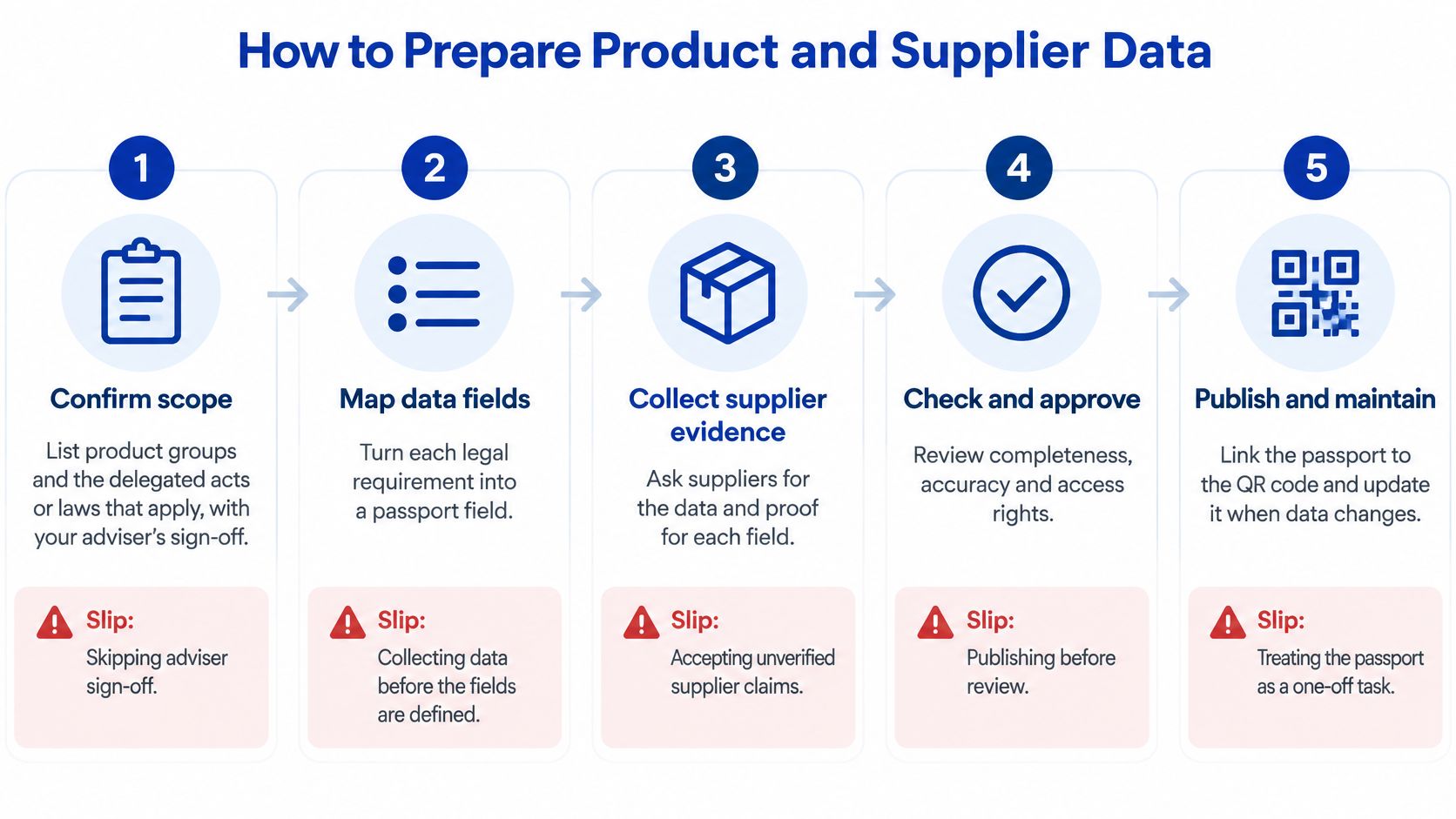
Compressed to five stages, the same routine reads as scope, field mapping, supplier evidence, review, then publish and maintain. The compression is useful when you're explaining the work to a manager who has five minutes.
Supplier collaboration is the step teams underestimate most often. It's also the one where a link beats an email attachment: a supplier that opens a page showing exactly the fields it owns, and nothing else, tends to answer within days rather than quarters. That's the model behind supplier data collection for passports, where answers are reviewed and approved before they enter the record.
The direction of travel is clear enough to justify starting now. A 2025 global survey of more than 400 supply-chain professionals across 55 countries found that 18% of manufacturers were already using Digital Product Passports, while 63% expected wider adoption within three years, according to Loftware.
In our platform, the routine sits on the product record itself: users create a product with its identifiers and materials, see which passport fields are still missing, then publish the passport, print the QR code and release a new version whenever the data changes.
Frequently Asked Questions About Digital Product Passports
Is a DPP the same as a QR code?
No. The QR code is the carrier that opens the record. The passport is the structured dataset behind it: identifiers, materials, substances, repair and disposal fields, each with an audience and a version history.
Does every product need a DPP today?
No. The date already fixed in law is the battery passport: 18 February 2027 for electric-vehicle, light means of transport and industrial batteries above 2 kWh. Other groups sit on different tracks: some wait for an ESPR delegated act, while packaging, construction products and critical raw materials follow separate legislation. Plan by legal basis, not by a single EU date.
Do imported products need one?
Yes, where the product is placed on the EU market, regardless of where it is manufactured. An importer selling into the EU is an economic operator, so goods made outside the bloc are inside the obligation once sold there.
Can one passport cover a whole product range?
Only where that group's rules and the underlying data allow it. Passports can be set at model, batch or item level; if regulators or customers check a specific unit, a brochure-style page for the range will not answer the question.
Who sees commercially sensitive fields?
The public page shows only fields marked public. Restricted fields stay behind access classes for the audiences you set, and export lets you keep a copy of the product data you have released and held back.
Does software make my products compliant?
No. Software organises fields, flags missing required data and publishes versions. The compliance call stays with your company and its legal or compliance adviser, alongside testing and certification where the group requires them.
Confirm Your Scope and Request a Demo
The next action isn't procurement. It's a short scope exercise: list your product groups, match each one to a legal basis, and have your legal or compliance adviser confirm which requirements bind you and from when. Everything else follows from that list.
Once it exists, a demo of DPPWare shows the workflow running on your own product data rather than on a sample. DPPWare is B2B digital product passport software built for manufacturers, brands and suppliers. In the platform, each field is filled and given an audience before a versioned passport is published, and every published passport gets a public page and a printable QR code.
Textiles work out of the box with a ready field set. Other industries are set up as a customer project with their own fields. What the demo won't do is tell you that you're compliant: that call belongs to your adviser, your testing lab and your certification body.
A demo of DPPWare shows the parts of this topic that are hardest to picture from a regulation: a product record with its missing fields flagged, supplier requests that ask only for what each supplier owns, and field-level access that separates the public page from the restricted views. Bring one product range and we'll walk through the workflow on your data, so you can see which fields you can fill today and which need a delegated act first.
This article explains regulations in general terms and is not legal advice. For a binding assessment of your products, check with your legal or compliance advisor.