Blog
Extended Producer Responsibility: A Practical EU Guide
Extended producer responsibility makes the company that places a product on a market answerable for what happens to it after the customer has finished with it, which means paying for collection and treatment and proving the quantities and materials involved. For compliance, sustainability and product-data managers at manufacturers, brands and importers selling into the EU, that duty now lands on product records as much as on invoices. This guide works through what the rules ask for, which product groups they cover, what data you need to keep, and how to build a process that survives several national registers at once.
Table of Contents
- What Extended Producer Responsibility Means
- Which Product Categories Carry EPR Duties and When
- The Product Data EPR Requires You to Keep
- How EPR Fees Respond to Product Design
- Selling Across Several EU Markets
- How to Build an EPR Data Process
- Common Questions and Your Next Step
What Extended Producer Responsibility Means
Extended producer responsibility (EPR) makes the producer answerable for a product's end-of-life obligations, not only for the sale. The easiest way to picture it is a warranty that outlives the sale: the carton leaves your warehouse, the invoice is paid, and your obligations keep running while the product is used, collected and treated.
Three working parts sit inside that idea. A producer identifies the products and packaging it places on a market. It finances or organises collection, treatment and recycling, usually through a producer responsibility organisation or a national scheme. Then it reports quantities and materials, and those reports decide the fee. Skip the third part and the first two fall over, because nobody can prove what was placed on the market.

The model spread quickly. The OECD's 2016 review counted approximately 400 EPR systems operating worldwide, with nearly three-quarters established since 2001, and it found small consumer electronics represented in more than one-third of the identified systems, while packaging and tyres each accounted for 17% (OECD policy highlights on extended producer responsibility).
France is the milestone most often cited. It applied EPR to household packaging waste as early as 1992, then extended the principle to additional product categories and material streams. The same review found evidence that in countries such as France EPR shifted part of the financial burden from municipalities and taxpayers to producers and reduced public waste-management costs.
That history explains why modern EPR is no longer a recycling target with a logo attached. It's a records obligation: identify the product, finance its end-of-life management, report quantities and materials, and coordinate with approved collection or recovery systems. Accurate product and supplier data became an operational requirement at the same moment it became an environmental one.
A test you can run this afternoon: for each product in your range, ask whether you place it on a market where an EPR system exists for that product group. If the answer is yes, or you're not sure, you already have an EPR obligation to scope.
Which Product Categories Carry EPR Duties and When
A power tool shipped in a printed box sits under two EPR systems before the first unit sells: one for the tool, one for the box. Scale that across a catalogue and the scope question changes from "does EPR apply to us" to "which rows of this table apply to which product, and in which markets." Read the status column closely. It tells you whether to act now, plan around a fixed date, or track a delegated act that has not been written yet.
| Product category | Legal basis | What producers usually handle | Status to check |
|---|---|---|---|
| Packaging | Packaging and Packaging Waste Regulation | Packaging quantities, materials and fees to schemes | Applies directly across the EU from 12 August 2026; national administration may differ |
| Electrical and electronic equipment | WEEE Directive 2012/19/EU | Quantities placed on the market by category, take-back financing | In force; national rules differ by Member State |
| Batteries | EU Battery Regulation (EU) 2023/1542 | Battery EPR provisions and battery passport data | Battery passport requirement starts 18 February 2027 for EV, LMT and industrial batteries over 2 kWh |
| End-of-life vehicles | Directive 2000/53/EC | Vehicle take-back and treatment obligations | In force; check national implementation |
| Textiles | ESPR, Regulation (EU) 2024/1781 | Product data under delegated acts; national EPR where schemes exist | Delegated acts still to come; no date set |
| Furniture | ESPR; national schemes in some Member States | Product data and end-of-life financing where schemes exist | Delegated acts and national rules still to come |
| Tyres | National EPR schemes in several Member States | End-of-life collection and recycling fees | Check each market separately |
| Construction products, metals, automotive components | ESPR, Regulation (EU) 2024/1781 | Product data under future delegated acts | Delegated acts still to come; no date set |
Packaging is the stream where reporting is most settled, and the reason is age: schemes have collected quantities for years, so the numbers turn into published national statistics as a matter of routine. The UK government's official statistic records that 73.2% of UK packaging waste was recycled in 2024 (UK statistics on waste). Your own packaging reports feed the same kind of national figure, which is why the quantities and material weights behind them have to hold up under audit.
Material rules also move independently of fees. If a packaging change on your roadmap is driven by a ban rather than a scheme charge, check the global plastics ban timelines explained before you commit to a redesign, because a format that satisfies one rule can fail another. When packaging is your largest exposure, the per-component view in packaging data handling covers material, recyclability and recycled-content fields for each item you ship.
One product, several obligations
Categories overlap, and scope errors usually start at the seams. A battery inside an electronic device sits under both electrical equipment and battery rules. A textile product in a polybag triggers textile obligations and packaging obligations at once. A car part sold as a spare carries automotive and packaging duties. Each extra obligation is also a separate registration and a separate set of figures to defend. Compliance managers who count products rather than obligations under-scope the job every time.
Where the battery passport applies
Battery rules carry the clearest fixed date in the table. The EU Battery Regulation sets 18 February 2027 as the date from which every electric-vehicle battery, every light means of transport (LMT) battery and every industrial battery with a capacity greater than 2 kWh placed on the EU market or put into service must have an electronic battery passport (EU Battery Regulation (EU) 2023/1542).
Scope test: take the battery category first. Only if the battery is industrial does the 2 kWh capacity threshold decide whether a passport is needed.
The passport has to carry model-level information and information specific to the individual battery, including data generated by its use. Your records therefore need two layers: reusable attributes that belong to the model, and item-level or operational values that belong to the unit. The legal text also states that a battery passport ceases to exist after the battery has been recycled.
Why the status column matters most
Three kinds of status sit in that table, and they demand three different responses. Rules in force now mean you register and report against them. Rules with a date fixed in law mean you build towards that date. Product groups under ESPR delegated acts still to come are named, but the field lists and dates are not.
Each live duty also creates a paper trail: a registration in that market, periodic quantity reports, and the product and supplier records behind the figures if a scheme or authority asks. The financing obligation and the records obligation arrive together, and treating them as separate projects is how reported numbers end up unprovable.
Requirements differ by product group, and many are still being defined. Before you commit budget to any single category, confirm the national rules in each market you sell into, and confirm the battery scope for your specific products, with a legal or compliance adviser.
The Product Data EPR Requires You to Keep
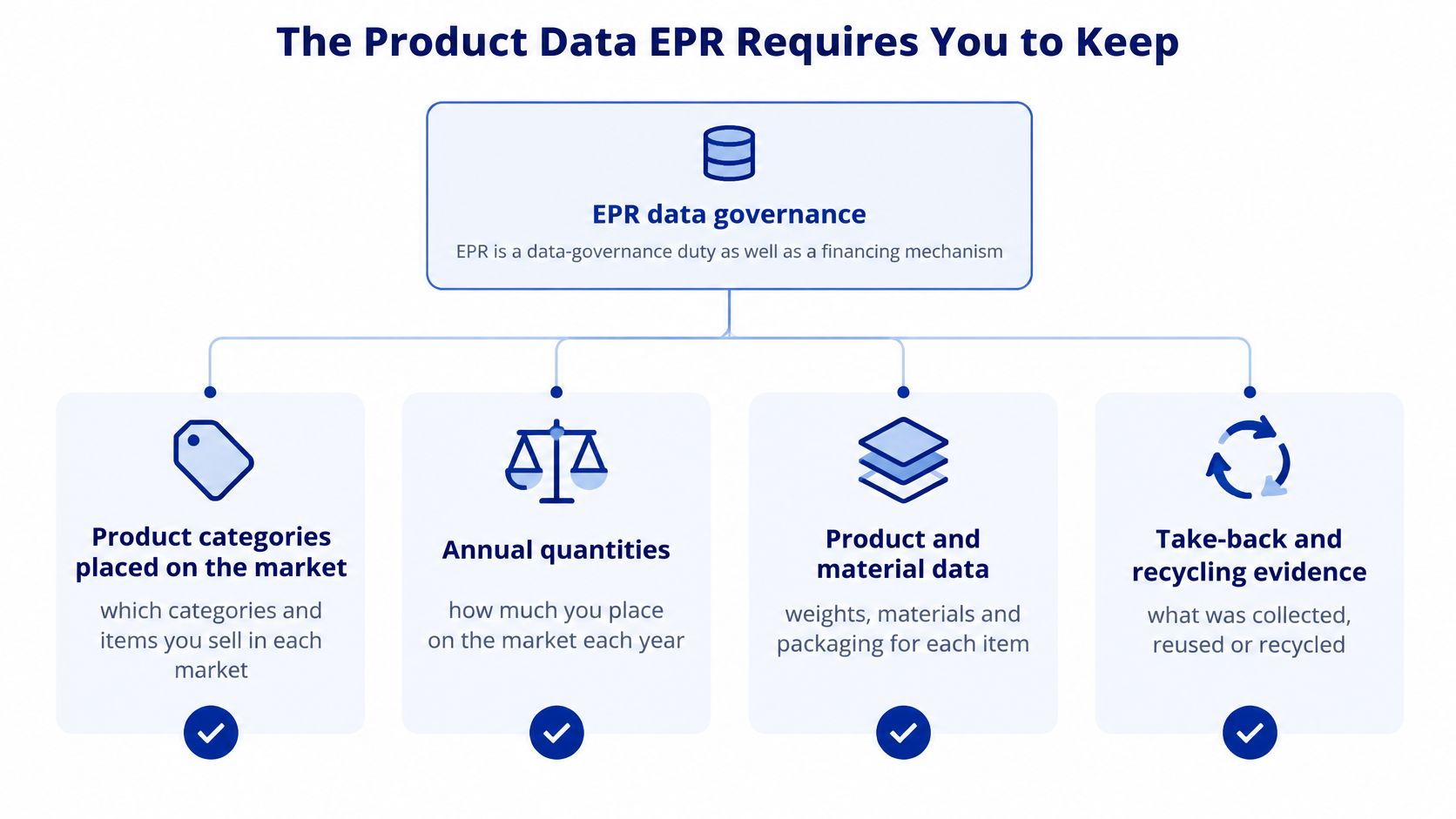
EPR is a data-governance obligation as much as a financing mechanism. Producers may need to maintain and report the product categories they place on a market, annual quantities, product and packaging weights, constituent-material types, and, in performance-oriented systems, the resulting collection, treatment, recycling and compliance data.
The reason this belongs to product teams rather than finance alone is the control chain behind every submitted figure. Product master data determines scope. Sales or market-placement data determines quantities. Bills of materials determine material weights. Approved downstream reports support treatment and recycling claims. Break any link and the number on the form is an assertion rather than a record.
National registers hold what regulators need to check that chain. Typical contents are producer identities, quantities placed on the market, packaging and packaging-waste information, and progress towards waste-management targets, alongside the collection, processing and payment data that show whether a system works. The details differ by country, but the pattern is the same: whoever files the figures has to be able to show where each one came from.
Fields to keep for every model
| Data group | Example fields | Why it matters for EPR |
|---|---|---|
| Identification | Model, batch or item identifier; persistent product identifier; data carrier | Defines the scope of each reported product |
| Economic operator | Manufacturer, importer, authorised representative contact | Shows who is responsible in each market |
| Materials and weights | Bill of materials, material types, product and packaging weight | Basis for quantities and material reporting |
| Substances | Substances of concern, additives, hazardous content | Informs treatment and fee criteria |
| Circularity | Recycled content, recyclability, separability, repairability | Supports recycling and design claims |
| Evidence | Supplier declarations, test reports, version number, source date | Lets you defend reported figures in an audit |
| Market quantities | Units placed on each national market, reporting period | Basis for national registers and fee calculation |
Substance fields deserve their own workflow rather than a column in a spreadsheet. This explanation of substances of concern covers what counts and how to record it so the same declaration serves both treatment requirements and fee criteria.
Why one country's fields won't travel
The World Bank's global EPR indicator covers 145 economies and distinguishes waste streams including packaging, e-waste, batteries and fishing gear, but it warns that definitions, measurement points, methodologies and data availability are inconsistent (World Bank EPR indicator). Reporting rules can change the number itself. EU rules moved the official calculation point in 2020, from the output of sorting facilities to the input of final recycling operations after deducting sorting residues and non-target materials, and the European Parliament Research Service reports that this accounting change reduced the reported EU packaging-recycling rate by 3.4 percentage points without indicating a corresponding decline in physical recycling activity (EPRS briefing on packaging and EPR791501?locale=EN)).
Each market also means a separate registration with its own field set and its own filing rhythm, so a record built for one country's portal rarely answers another's without rework.
Assume nothing transfers unchanged between Germany, the wider DACH region and other EU markets. Keep one central record with supplier review, approval history and exportable evidence, then present market-specific views from it. That way a recycled-content figure or a material weight is collected once, verified once, and reformatted per register rather than rebuilt per country.
Where accountability sits: responsibility for the content of product data stays with your business, even when a supplier supplies the values. A declaration you forwarded without checking is still your declaration.
How EPR Fees Respond to Product Design
Take two versions of the same jacket. One is a single-material, mono-fibre shell with no coating. The other is a bonded blend with a membrane, a laminated zip guard and a solvent-based print. Both weigh roughly the same and both sit in the same product category, yet they cost the waste system different amounts to handle. A weight-only fee charges them the same.
A modulated fee does not.
OECD analysis defines fee modulation as varying producer payments according to measurable design characteristics, so products that are harder or more expensive to manage at end of life carry more of that cost (OECD working paper on EPR fee modulation16/En/pdf)). The mechanism is deliberately simple: better design lowers expected waste-management costs and reduces the fee, while a design with no recycling route makes redesign the cheaper option. Every criterion is something a scheme has to measure, which means the fee you pay is only as good as the product data behind it.
| Design characteristic | Typical fee effect | Evidence to keep |
|---|---|---|
| Weight only (baseline) | Charged on weight, no design adjustment | Verified weight per product model |
| Recyclability | Lower fee where the product is designed for recycling | Recyclability assessment and version date |
| Material complexity | Higher fee for mixed or laminated materials | Bill of materials with material types |
| Hazardous content | Higher fee where hazardous substances are present | Substance declarations and test reports |
| Repairability | Can lower fee where repair supports longer use | Repair documentation and spare-part availability |
| Established recycling route | Lower fee where a proven route exists | Confirmation of the route from the recycler or scheme |
Fee modulation also reaches upstream. The same OECD analysis reports that modulated fees increased the share of research and development spending directed toward recyclability, with associated gains in recycling rates and lower virgin-material consumption.
One trade-off deserves attention before your design team celebrates. The same analysis found that redirecting R&D toward recyclability was associated with shorter product lifetimes and lower technical quality in some scenarios. A jacket that recycles beautifully but lasts two seasons relocates the problem instead of solving it. Weigh design changes against durability, and record the reasoning so the decision survives an audit as well as the fee calculation.
Packaging designers face the same constraint. When recyclability becomes a design requirement, format choices affect both commercial appeal and the fee a scheme charges, and this sustainable packaging outlook for cannabis brands illustrates how one consumer-facing sector already weighs shelf presence against material recovery.
Fee criteria are scheme-specific, so the same design change can cut the fee in one market and leave it unchanged in another. A design decision therefore calls for a fee review in every market where the product is registered. Behind each review sits the same evidence: the verified weight, bill of materials, substance declarations and supplier confirmations you hold for that model are what you submit, and what you would produce if the scheme questioned your figures.
Practical rule: map each fee criterion to a controlled product specification, so a design change automatically triggers a fee review. A fee schedule treated as a finance-only calculation drifts out of date within a season, and a fee assessment built on unverified supplier declarations creates both overpayment and reporting risk.
Selling Across Several EU Markets
EU rules apply directly, but that doesn't turn EPR into a single EU-wide registration. The European Parliament's 2026 briefing notes that, despite directly applicable EU rules, differences can persist between Member States in administration, implementation and enforcement (European Parliament Research Service). It also records that an EU-based producer may currently need an authorised representative in each other Member State where it first places products on the market, while non-EU producers face separate representative requirements.

A worked example across two markets
Say a textile brand based in Germany sells the same jacket model in France and Italy. The model identifier is one thing. The quantities are three numbers, because each market has its own reporting period and registration. The packaging composition is constant, but the evidence each scheme accepts isn't, and the representative arrangement differs per country. Run the same logic for a battery pack sold in four markets and the count of obligations, not products, is what fills the compliance calendar.
The overlap bites hardest in textiles, batteries, electronics and packaging, where one model can trigger several waste-stream obligations at once. The practical gap is the link between EPR reporting and upstream product data: model identifiers, quantities placed on each market, packaging composition, battery chemistry, supplier evidence and the records that prove reported figures.
The direction of travel is partial harmonisation rather than simplification. A directly applicable regulation removes one layer of national transposition, but administrative and enforcement divergence can remain.
Take three questions to your legal adviser before you register anywhere new: which markets trigger an authorised representative for your entity type, which reporting periods apply in each, and which forms of evidence each national scheme accepts. Then keep one product and material data set with market-specific views, rather than a separate spreadsheet per country.
How to Build an EPR Data Process
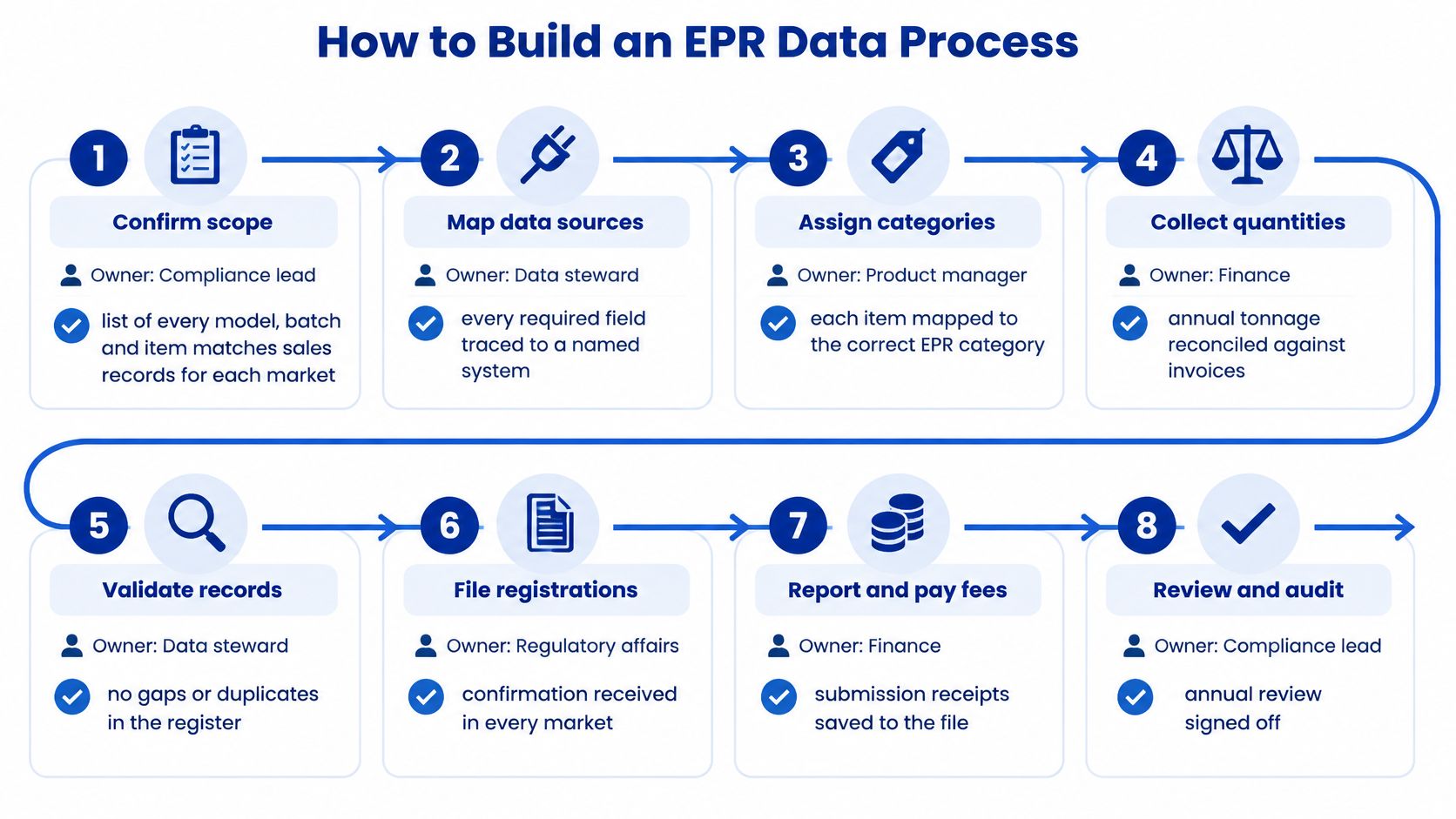
A workable EPR process is short enough to run every quarter and specific enough that an auditor can follow it. Eight steps, each with one owner and one check.
- Confirm scope. List every model, batch and item you sell, and the market each one reaches. Check: the list matches sales records for each market, with no product lines missing.
- Assign owners. Name one person for identifiers, one for materials, one for supplier requests and one for market quantities. Check: every field in the record has a named owner.
- Map to categories. Place each product group against the category table and its legal basis. Check: each product maps to a category, and every status is marked as in force, fixed date or delegated act to come.
- Build the record. One record per model with the common data core of identification, economic operator, materials, substances, circularity and evidence. Check: no required field is blank.
- Request supplier data. Send each supplier a link that asks only for the fields they own, then review and approve the answers before they enter the record. Check: nothing publishes on an unreviewed declaration.
- Run completeness checks. Record how complete each section is, so gaps are visible before a reporting deadline. Check: the readiness report shows what's outstanding and who owes it.
- Publish with version control. Required fields are checked before release, and every release keeps an activity log. Check: the previous version stays retrievable.
- Export and review. Export the data for national reporting, then review at each reporting period and whenever a product changes. Check: submission receipts are stored against the record.
What stays the same in every industry
The sequence doesn't change between textiles, batteries, furniture and metals: create the product, request data from suppliers, review what comes back, publish and maintain. What changes is the field set, which is why a template copied from another business unit rarely survives contact with a real supplier base. Product data management is the part our software handles, keeping one record per product with its identifiers, materials, suppliers and completeness per section, then publishing with required-field checks, versioned releases, QR-code passport pages, an activity log and CSV export.
Under ESPR, the digital product passport attaches to a persistent unique product identifier through a data carrier, has to interoperate with other passports required under delegated acts, and must stay accurate, complete and up to date (ESPR text). A QR code alone doesn't satisfy that; it has to resolve to an identity that stays maintainable.
What software can't do: it organises records and shows where they're thin. It doesn't make you compliant, and it doesn't replace certification or testing. Product-group requirements still come from the applicable delegated acts, and the content of your data stays your responsibility.
Common Questions and Your Next Step
Does EPR apply if I import from outside the EU?
Yes, in most schemes, and often through an authorised representative rather than directly. Importers and non-EU producers carry their own registration and representative rules, and those rules differ per market. Confirm your position with a legal adviser before you sell into a market, not after the first invoice.
Does software make me compliant?
No. Software holds the records behind your figures: which products you placed on which market, what they contain, and which supplier statements support each number. It organises that evidence and shows where it is thin. Registration, reporting, certification and testing stay with your business and your advisers, and the content of your data stays your responsibility.
What if my product fits no listed category?
Go back to the scope test: are you placing the product on a market where a scheme exists for that group? If the category isn't named yet, the requirement may still arrive through a delegated act, and a national scheme may already apply. Ask your adviser which of the two you're facing.
What if a supplier won't share material data?
You can't report what you can't evidence, so the gap becomes a commercial conversation. Ask for the exact fields rather than "full material data", give a deadline, and escalate through procurement. Keep track of who owes which answer by when. An unreviewed declaration you forwarded is still your declaration.
Where should I start?
Three lists: your products, your markets, and your suppliers. The market list is usually longer than assumed once each country's separate registration is counted, and the supplier list tends to have gaps where material data lives only in a contact's inbox. Together, those lists show how much evidence your fee calculations can defend.
DPPWare builds B2B software for Digital Product Passports, hosted in Germany with its data centre in Nuremberg. Each product record holds identifiers, materials, suppliers and completeness per section, and supplier answers come in through a link that asks for exactly the fields they own, then get reviewed before they enter the record. Textiles work out of the box; batteries, electronics, furniture, construction products, metals and packaging are set up as a customer project with their own field set. Every engagement starts with a conversation about your products and suppliers, so bring those three lists to DPPWare and map them against the fields you'll need to defend.
This article explains regulations in general terms and is not legal advice. For a binding assessment of your products, check with your legal or compliance advisor.